
AI is making cost-benefit analysis (CBA) simpler, faster, and more accurate for small and medium-sized enterprises (SMEs). Traditional methods are slow, prone to errors, and heavily reliant on manual work. AI tools automate data collection, reduce mistakes, and provide real-time insights, allowing SMEs to make better decisions without needing large financial teams. For businesses looking to get started, AI consultancy can help identify the best tools for the job.
Key takeaways:
AI-powered CBA helps SMEs allocate resources wisely, avoid common pitfalls, and use automation techniques for SMEs to make decisions based on data rather than assumptions.
Performing a thorough cost-benefit analysis (CBA) manually can be a daunting task. It’s not only time-intensive but also susceptible to errors, often resulting in outdated conclusions by the time the process is complete. These challenges can slow down decision-making and lead SMEs to draw inaccurate conclusions, highlighting why traditional methods often fall short for small and medium-sized enterprises.
Manually gathering and organising financial data is a slow and laborious process. SMEs often spend as much as 28 hours a week on administrative tasks like data entry. Sifting through invoices, bank statements, supplier contracts, and sales records can quickly become overwhelming.
On top of that, fragmented data often needs extensive cleaning before it can be used. For every £1 spent on cleaning data, the associated cost can range from £3 to £5, with the effort required being two to three times more than expected. What should be a straightforward analysis can feel more like an archaeological dig through layers of disorganised information.
"AI is only as good as the data that fuels it. Investing in proper governance saves costs and headaches in the long run." – Nguyen Le, COO, SmartDev
Once data is collected, testing various scenarios introduces another set of challenges. Manual scenario testing often involves reworking large spreadsheets for even the smallest adjustments, turning what should be a quick task into an hours-long ordeal.
Take the example of the business planning team at the University of North Texas System. Previously, they relied solely on Excel for scenario modelling, where running a single scenario could take an entire day. By switching to automated planning tools, they reduced this process to just a few minutes by simply changing inputs. For SMEs, these delays can be costly - by the time multiple scenarios are evaluated, market conditions may have already shifted, rendering the analysis irrelevant.
Manual calculations are prone to mistakes that can distort the outcome of a CBA. Common errors include double-counting, overlooking adjustments for future cash flows, and basic arithmetic mistakes. Even more concerning, manual methods are vulnerable to bias, where stakeholders may unintentionally overestimate benefits or downplay costs to align with a preferred decision.
Valuing intangible factors like brand equity or customer loyalty adds another layer of complexity. Manual methods often rely on "heuristics", or mental shortcuts, to estimate these values, leading to rough guesses rather than accurate figures. This approach can result in decisions based on flawed assumptions rather than solid data. In the UK, around 20% of new businesses fail within their first year, often due to poor financial management and decision-making.
"Information on costs, benefits, and risks is rarely known with certainty, especially when one looks to the future. This makes it essential that sensitivity analysis is carried out." – Dr. Josiah Kaplan, Research Associate, University of Oxford
AI has transformed cost-benefit analysis (CBA) for small and medium-sized enterprises (SMEs), making the process faster and more efficient. Instead of relying on time-intensive manual methods, AI automates key steps, offering real-time insights that used to require a dedicated finance team. What was once the domain of expensive enterprise systems is now accessible through intuitive software tailored for smaller businesses.
AI tools simplify financial data management by pulling information from various digital sources and converting it into structured reports and dashboards. For instance, platforms like Docuf.AI handle data entry from documents automatically, while accounting AI systems can log expenses, flag overdue invoices, and organise digital records in just minutes.
But AI doesn’t stop at basic tasks. Using natural language processing, it can uncover hidden costs that might have been overlooked. Generative AI tools, for example, can help brainstorm and categorise direct, indirect, and intangible costs specific to your business. It can even transcribe meeting notes or phone calls into actionable data points, ensuring qualitative insights are not missed. Features in modern spreadsheet tools, such as Excel’s "Analyse Data" button, let users ask plain-English questions - like, “What’s the total cost of indirect items?” - to instantly generate charts and pivot tables, saving hours of manual effort.
When it comes to scenario testing, AI dramatically speeds up the process. It can adjust variables and run multiple "what-if" scenarios in minutes, allowing SMEs to explore different cost and benefit combinations quickly. For example, AI can handle sensitivity analysis by tweaking costs and benefits - such as increasing costs by 10% and reducing benefits by 10% - to see how these changes impact project viability.
"AI streamlines data analysis and provides predictive insights, enabling informed decision-making and more accurate assessments." – Marshall Hargrave, Financial Writer, QuickBooks
Predictive analytics take it a step further, helping SMEs forecast sales, market trends, and inventory needs based on historical data rather than guesswork. This capability ensures decisions are grounded in data, not assumptions.
AI also integrates live data into cash flow predictions and performance metrics, pulling information directly from accounting software and bank feeds. This ensures that your CBA reflects the latest market conditions, not outdated figures. Additionally, AI tools can scan industry reports to provide benchmarks - like average productivity gains for specific technology upgrades - giving you a solid foundation for assessing potential benefits.
These real-time insights empower SMEs to make smarter, data-driven financial decisions. Companies leveraging AI report a 3.5 times greater annual boost in customer satisfaction.
Conversational AI adds another layer of convenience, allowing users to query data in plain English. This makes it easy to dive into specific cost or benefit categories without wrestling with spreadsheets. AI can also identify hidden patterns in large datasets, such as trends in customer behaviour or inventory demand, leading to more accurate long-term forecasts. And as these systems process more data over time, they become increasingly effective, improving their performance with continued use.
Building on how AI simplifies cost-benefit analysis (CBA), here’s a straightforward three-step guide to applying it in your small or medium-sized enterprise (SME).
You don’t need a technical background or a dedicated finance team to run a cost-benefit analysis with AI. These steps make the process manageable and can change how SMEs evaluate their business decisions.
AI takes the hassle out of manual data collection and cleaning. Start by pinpointing the metric you want to predict - such as "total project costs" or "expected revenue increase" - and then gather the necessary data. AI tools can pull information from your existing systems, whether it’s a CRM, accounting software, or spreadsheet files. No-code platforms can connect live data sources like Google Sheets or Salesforce, while automation tools like Zapier ensure your model stays updated. Machine learning also helps by cleaning data, handling tasks like deduplication and error correction.
Take the example of Sarah Kemp, Operations Manager at BrightLeaf Foods. In 2025, her company adopted an automated order tracking system using we.simplify. Within just three weeks, they transitioned from manual spreadsheets to an automated process, saving at least 10 hours of work per week. Reflecting on the change, she shared:
"Before working with we.simplify, we were drowning in spreadsheets and manual processes. Within three weeks, they had automated our order tracking, and now I no longer spend time chasing numbers".
Once your data is in order, you’re ready to let AI do the heavy lifting.
With your data organised, AI takes over the number-crunching, even for the most complex calculations. Simply upload your historical data, select the target variable, and let the AI model uncover patterns. This process can take seconds for simpler models or a few minutes for more complex ones. Unlike traditional spreadsheet formulas, machine learning identifies intricate, non-linear patterns that manual methods might overlook. For instance, in one cost-modelling exercise using 1,338 rows of data, an AI model achieved a Mean Average Error of under £2,400 for charges ranging up to approximately £51,000. These systems also adjust for present value and run sensitivity tests automatically.
James Patel, Director at Silverline Marketing, saw this efficiency in action. In 2025, his company implemented an AI-driven integration between their CRM and invoicing system. Describing the experience, he said:
"I'm not a tech person, but they explained everything in plain English... They built an integration between our CRM and invoicing system that cut billing time in half".
Once the AI model has finished its calculations, you can easily compare different scenarios. AI platforms display critical metrics like net present value (NPV), return on investment (ROI), and payback periods on real-time dashboards, making side-by-side comparisons effortless. Unlike traditional spreadsheets that require manual recalculations, AI adjusts these figures instantly. Most systems aim for projects that recover costs within 18 to 24 months. You can also tweak discount rates to test the reliability of each scenario - if the results remain positive, the project is financially sound. For ongoing initiatives, AI tools can integrate with existing workflows via API connections or automation platforms, ensuring continuous updates without manual intervention.
A great example of this approach comes from Yorkshire-based Trust Electric Heating. Between 2023 and 2025, co-owner Fiona Conor led an AI implementation to automate sales follow-ups. The results? A staggering 500% boost in productivity and a 50% reduction in cost per lead. These gains allowed the company to triple both its workforce and turnover.
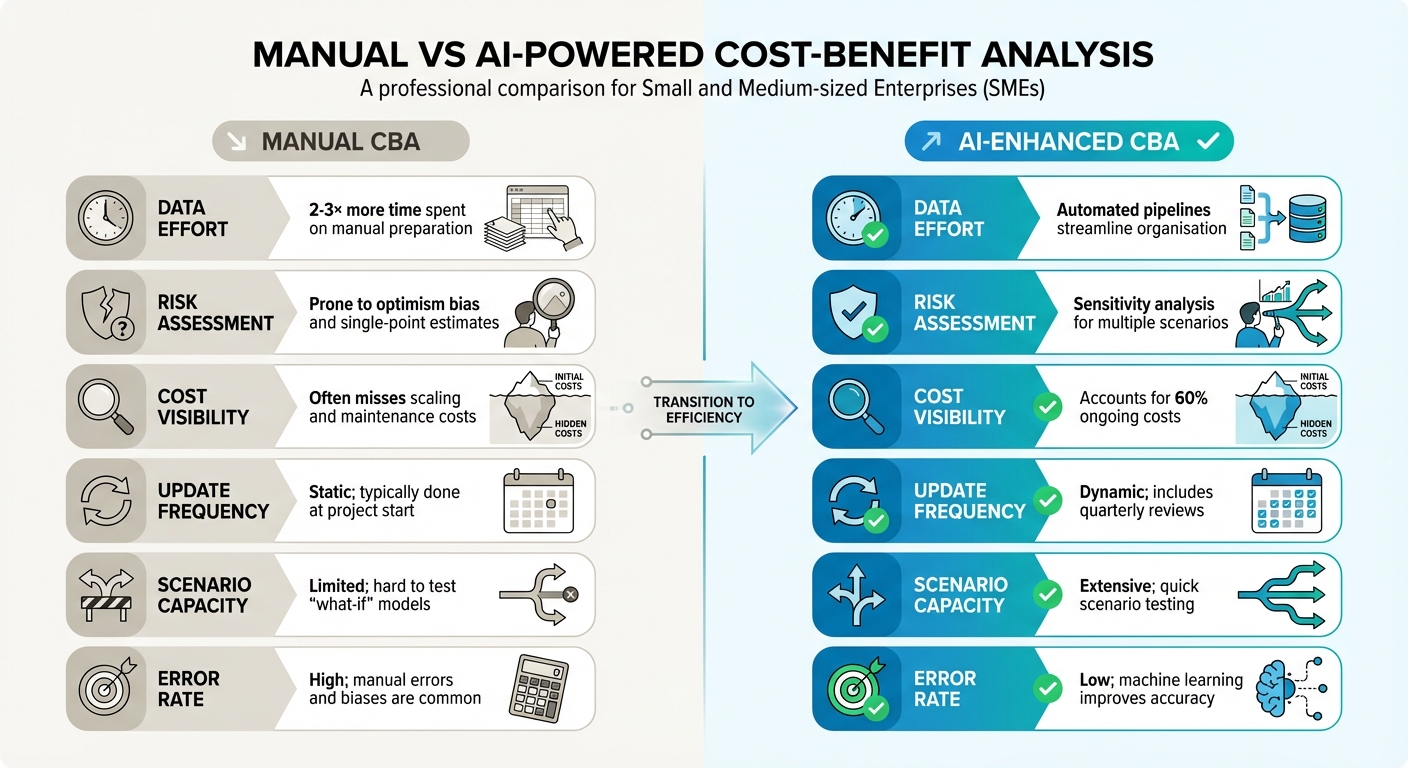
When it comes to cost-benefit analysis (CBA), the difference between manual methods and AI-powered tools is striking. Traditional spreadsheets rely on static calculations, while AI automates data collection and analysis. This automation not only speeds up the process but also enhances accuracy and depth, making it easier to evaluate business decisions effectively.
Manual CBA often requires a significant effort in cleaning and preparing data, which can lead to overlooked hidden costs. In contrast, AI streamlines this process with automated data pipelines, accounting for ongoing expenses like maintenance, training, and scaling. For small and medium-sized enterprises (SMEs), these ongoing costs make up 60% of AI-related expenses, far outweighing the initial setup costs. Linh Chu Dieu, a Marketing Team Member at SmartDev, highlights this challenge:
"Businesses routinely underestimate AI project costs by 500% to 1000% when focusing solely on development expenses."
Risk assessment is another area where AI outshines manual methods. Traditional approaches are prone to optimism bias and rely on single-point estimates, which can give an overly rosy picture. AI, however, uses sensitivity analysis to evaluate multiple scenarios - base, upside, and downside - providing a more comprehensive risk forecast. This is critical because underestimating project costs can lead to significant financial setbacks, especially for SMEs operating on tight budgets.
MetricManual CBAAI-Enhanced CBAData Effort2–3× more time spent on manual preparation Automated pipelines streamline organisation Risk AssessmentProne to optimism bias and single-point estimates Sensitivity analysis for multiple scenarios Cost VisibilityOften misses scaling and maintenance costs Accounts for 60% ongoing costs Update FrequencyStatic; typically done at project start Dynamic; includes quarterly reviews Scenario CapacityLimited; hard to test "what-if" modelsExtensive; quick scenario testingError RateHigh; manual errors and biases are commonLow; machine learning improves accuracy
The OECD underscores the importance of sensitivity analysis, stating: "The impact of AI on productivity remains uncertain in terms of timing and scale... This uncertainty justifies using sensitivity analysis rather than single-point estimates". For SMEs, this shift from static guesswork to data-driven forecasting can be a game-changer. By removing the inefficiencies of manual data cleaning and reducing bias in risk assessments, AI equips businesses with the tools to make well-informed, confident decisions. This stark contrast highlights why embracing AI in cost-benefit analysis is becoming essential for smarter, more reliable decision-making.
Interpreting AI-generated data is essential for making informed decisions. Ben Sefton, an expert in AI strategy and policy, explains it clearly:
"AI ROI is the ratio of discounted net benefits to total costs, reported with payback and sensitivity for decision clarity".
Think of AI outputs as a starting point, not the final word. To truly understand their impact on your business, dive deeper than surface-level figures. This mindset helps you extract actionable insights that can shape meaningful business strategies.
When evaluating AI investments, ensure your Benefit-Cost Ratio is above 1 and aim for an ROI within the 15–25% range. This threshold accounts for the uncertainties that often accompany AI projects. Additionally, consider the payback period - the time it takes to recoup your initial investment. For automation initiatives, this is typically between 6 and 12 months. Regular performance reviews are crucial to verify these projections and adjust if needed.
It's worth noting that only 20% of time savings from AI projects translate into actual cash savings unless there’s a reduction in staff costs. The National Audit Office emphasises the importance of:
"Benefits realisation discipline requires discipline and named ownership throughout the project lifecycle".
Assign a dedicated person to monitor whether the anticipated savings are being achieved. Set up formal review checkpoints at 30, 90, and 180 days to compare AI projections with actual outcomes. If the benefits fall short by more than 25% at the 90-day mark, it may be time to rethink your approach.
Avoid relying on single-point estimates. As the OECD highlights:
"The impact of AI on productivity remains uncertain in terms of timing and scale".
To address this uncertainty, use sensitivity analysis to account for variables like adoption delays and fluctuating rates of implementation. Allow 3–6 months for users to adapt to AI outputs fully. Keep in mind that in 2025, 42% of organisations abandoned their AI projects due to overly optimistic productivity projections.
To ensure accuracy, validate AI results against industry-specific benchmarks. Maintain a benefits log to track planned versus actual adoption rates, time savings, and cost reductions. When calculating multi-year benefits, use a 3.5% discount rate to keep expectations realistic. By aligning AI insights with your business goals and verifying them against real-world data, you’ll be better equipped to make decisions that genuinely add value.
Manually conducting cost-benefit analyses can drain valuable resources for small and medium-sized enterprises (SMEs). This is where Wingenious steps in, offering expertise in implementing AI-powered systems that simplify the entire process - from gathering data to delivering actionable insights. With three decades of experience in digital transformation, Wingenious prioritises practical, no-nonsense solutions over technical jargon. This hands-on expertise enables them to deliver customised AI solutions tailored specifically for cost-benefit analysis.
Their process begins with AI Strategy Workshops, which focus on identifying "quick wins" - immediate opportunities to improve ROI by automating repetitive tasks or leveraging existing data for insights. To ensure projects are viable, AI Feasibility Studies evaluate your data, technical setup, and resources. This step minimises the risk of costly missteps and ensures that any investments align with your business needs.
Their Workflow Automation services are particularly impactful. Automating tasks like data entry and calculations frees up your team for more strategic work. The results speak for themselves: one client cut costs by 40% through back-office automation, another reduced manual work equivalent to two full-time employees, and a logistics business saved over 48 hours of manual work per week by integrating accounting and logistics systems. As Gary, the founder of Wingenious, puts it:
"Wingenious helps businesses design and implement intelligent AI-powered systems that improve efficiency, drive down cost and accelerate growth".
To ensure ongoing success, Actionable Data Dashboards provide real-time performance insights, making it easy to track whether your AI investments are delivering results. For SMEs working within tight budgets, Wingenious also explores affordable AI options and potential funding sources, such as Innovate UK grants. Their goal is to deliver measurable outcomes within 3–6 months while helping businesses build internal expertise.
Wingenious recommends starting with AI tools for general purposes to build confidence before moving on to more complex integrations. Their AI Strategy Development ensures that every AI initiative is tied to clear KPIs, creating a roadmap that evolves with your business. This approach keeps investments focused on delivering meaningful results and supports the kind of data-driven decision-making that can transform your operations.
AI has revolutionised cost-benefit analysis, turning what was once a lengthy and error-prone process into something far quicker and more precise. Tasks that previously took days to complete - and often relied on human judgement or guesswork - can now be handled by AI in mere seconds or minutes. This speed doesn’t come at the expense of quality either. Automated systems handle data collection and processing with an efficiency that significantly reduces the chances of manual errors.
The precision AI offers is equally noteworthy. Traditional methods often struggle when dealing with multiple interconnected variables, but AI thrives in such scenarios. It identifies patterns and relationships across numerous factors simultaneously, offering an impartial, evidence-driven perspective that helps eliminate personal bias. For small and medium-sized enterprises (SMEs) operating with limited budgets, this means gaining dependable insights without the need to hire costly data scientists.
One of AI’s standout advantages is its ability to perform rapid scenario testing. Dr. Josiah Kaplan, a former Research Associate at the University of Oxford, emphasises the importance of this:
"Information on costs, benefits, and risks is rarely known with certainty, especially when one looks to the future. This makes it essential that sensitivity analysis is carried out".
AI makes such robust testing accessible to businesses of all sizes. It enables organisations to explore various "what-if" scenarios, helping them understand how shifts in key variables might influence outcomes.
These improvements in efficiency and accuracy pave the way for a smoother AI adoption process. With these benefits clearly in view, seeking expert guidance becomes a practical next step. Specialists can help you overcome technical challenges, ensure your data is reliable, and identify quick wins that deliver measurable returns on investment within 3–6 months. Whether you’re considering government funding options like Innovate UK grants or starting small with budget-friendly AI tools, professional support ensures your efforts align with your business goals instead of chasing flashy but impractical solutions.
To take advantage of these benefits and align your cost-benefit analysis with your strategic objectives, visit Wingenious.ai : AI & Automation Agency.
AI brings a new level of precision to cost-benefit analysis for small businesses by automating intricate calculations and minimising the risk of human error. By tapping into real-time data and comparing it against industry standards, it ensures that decisions are grounded in the latest and most relevant information.
What’s more, AI can rapidly simulate various scenarios, allowing SMEs to explore potential outcomes and assess risks with much greater accuracy. This not only streamlines the decision-making process but also empowers businesses to make choices with greater confidence and efficiency.
AI is revolutionising how small businesses approach cost-benefit analysis (CBA), making it faster, more precise, and easier to use. With its ability to process vast amounts of data in seconds, AI enables businesses to explore multiple "what-if" scenarios almost instantly - something traditional tools like spreadsheets simply can't match. This speed and efficiency allow businesses to adapt quickly to market changes and make decisions with greater confidence.
Another game-changer is AI's ability to reduce human error. By automating calculations and updating results in real-time as new data comes in, AI ensures accuracy and consistency. It can also compare scenarios against industry benchmarks, helping small businesses pinpoint the most financially sound options without spending hours on manual analysis. By cutting through the complexity of spreadsheet modelling, AI saves time, giving businesses more room to focus on strategic growth and operational efficiency.
Small businesses can take advantage of AI for cost-benefit analysis by starting with manageable steps and focusing on specific goals. First, pinpoint the decision you need help with - whether it's automating a task or deciding on a new product investment. Collect reliable financial data, such as revenue forecasts, operating costs, and historical performance, and organise it in a clear, structured way.
Once you’ve got the data, try a low-cost proof-of-concept (PoC) to test AI tools. For example, use AI-powered analytics platforms to run basic scenarios. A PoC allows you to compare AI-generated results with manual calculations, showcasing potential time and cost savings without committing to a large upfront investment.
If the initial results look good, evaluate the impact using metrics like cost reductions, revenue increases, or productivity gains. To scale up, you might collaborate with an AI consultancy like Wingenious.ai. They can help refine the solution and provide training, so you can get the most out of AI without needing in-house tech expertise.

Our mission is to empower businesses with cutting-edge AI technologies that enhance performance, streamline operations, and drive growth. We believe in the transformative potential of AI and are dedicated to making it accessible to businesses of all sizes, across all industries.


