How AI Improves Market Demand Forecasting for SMEs
AI helps SMEs improve demand forecasts, cut errors and stockouts, lower costs, and make smarter decisions with real-time data and simple tools.
 · · 17 min read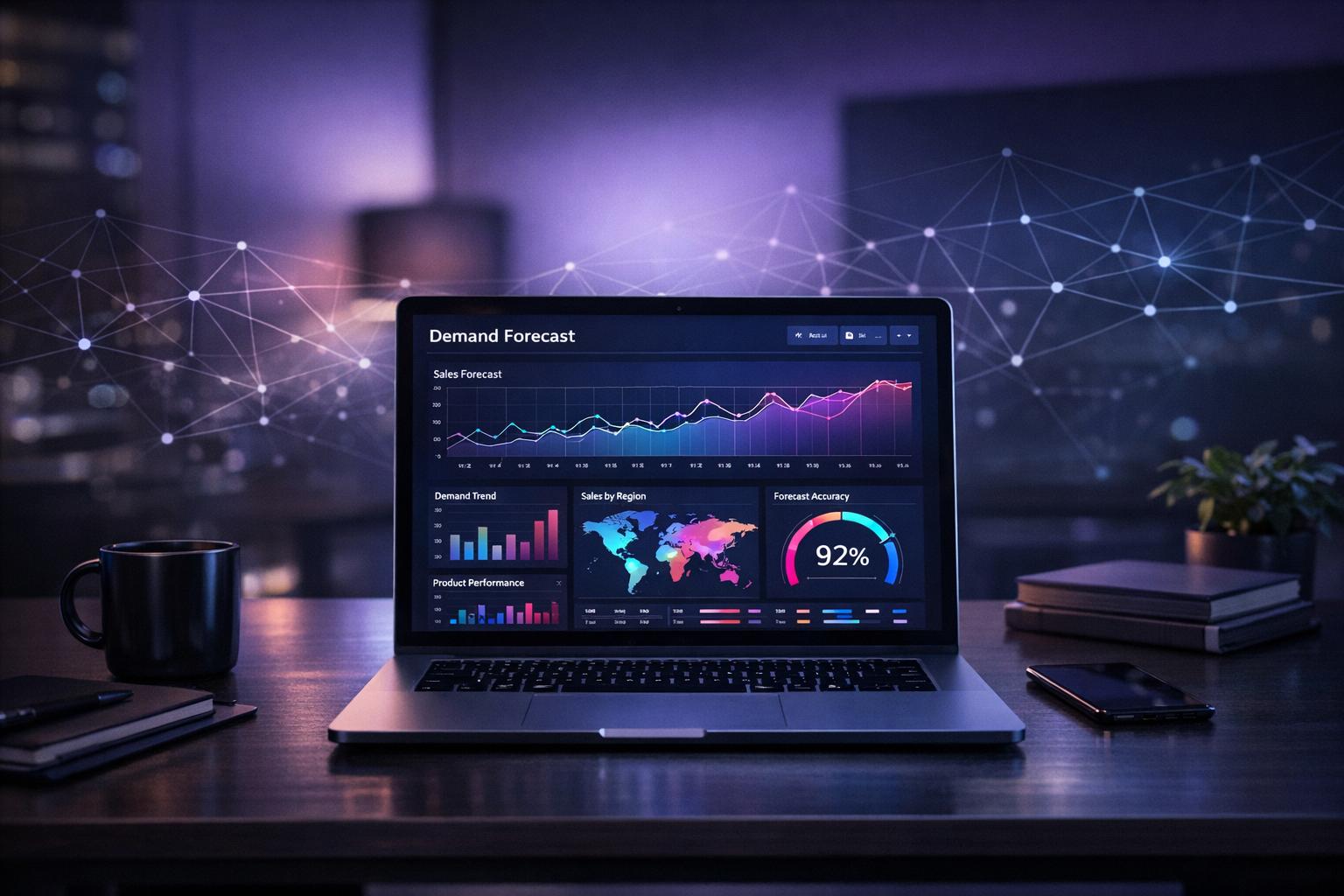
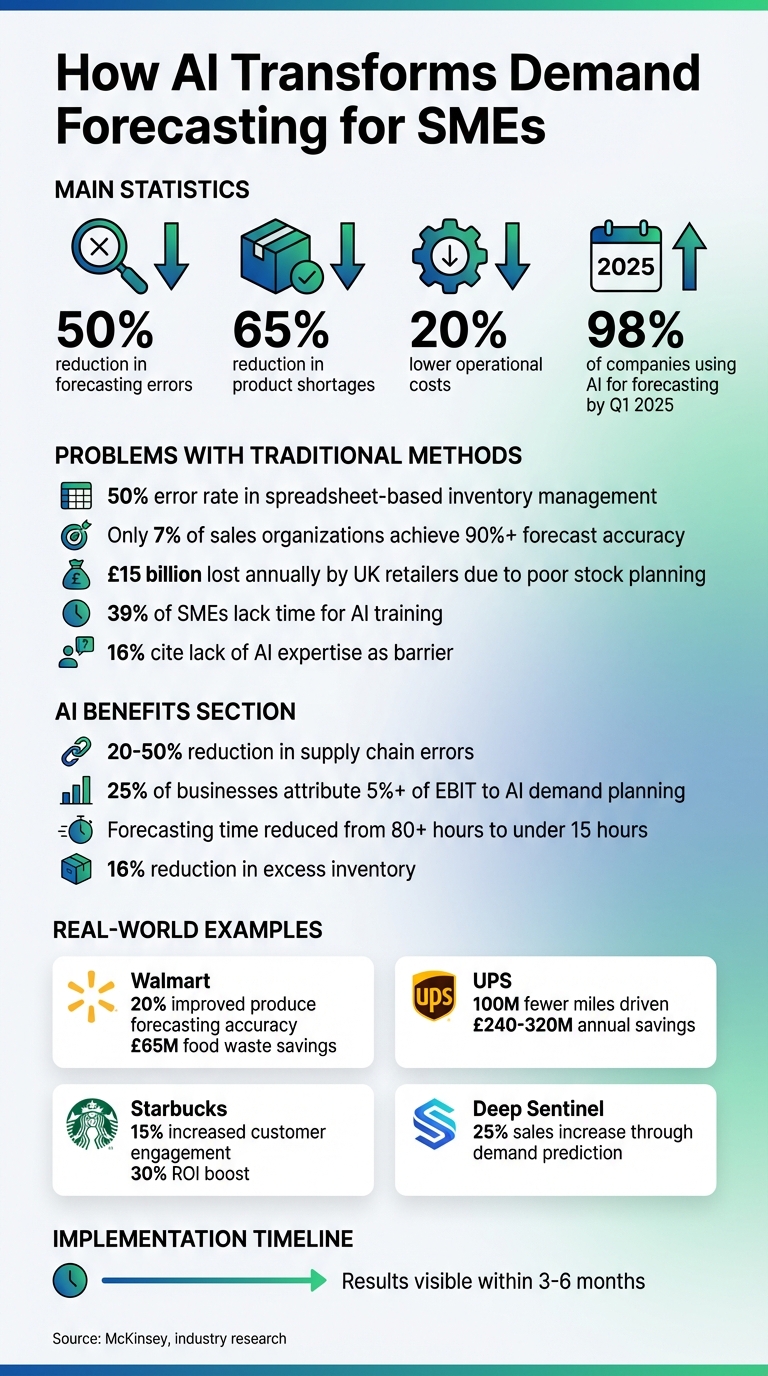
AI is transforming how small and medium-sized enterprises (SMEs) predict market demand, helping them save money, reduce waste, and make better decisions. Traditional methods often rely on outdated spreadsheets and incomplete data, leading to costly mistakes like overstocking or running out of products. AI tools solve these problems by analysing both internal and external data in real time, cutting forecasting errors by up to 50% and reducing product shortages by 65%.
Key takeaways:
- AI reduces errors: Up to 50% fewer forecasting mistakes compared to older methods.
- Real-time updates: AI reacts quickly to trends, weather changes, or unexpected events.
- Cost savings: SMEs can lower operational costs by up to 20%.
- Better decisions: AI helps businesses test scenarios and optimise inventory levels.
To get started, SMEs should focus on cleaning up their data, choose affordable AI tools, and consider AI strategy workshops for expert guidance. AI forecasting isn’t just for big companies anymore, it’s accessible, practical, and can deliver noticeable results within months.
AI Forecasting Benefits for SMEs: Key Statistics and Cost Savings
Problems SMEs Face with Demand Forecasting
While demand forecasting promises better planning, many SMEs still struggle with outdated methods that often create more issues than they resolve. These traditional approaches rely on obsolete data systems, providing a piecemeal view that misses critical market signals, from changing customer behaviours to sudden supply chain disruptions. Let’s explore the specific challenges that hinder effective demand forecasting for SMEs.
Poor Quality and Incomplete Data
Accurate forecasting starts with reliable data, but many SMEs are missing this crucial ingredient. A significant number of UK SMEs still manage inventory using spreadsheets, which often leads to duplicate entries and error rates as high as 50%. The problem is compounded when sales leads, marketing campaigns, and financial records are stored in separate systems. These data silos make it impossible to get a clear, overarching view of business operations. Without structured digital tools like CRM systems or proper inventory tracking, even advanced AI tools struggle to deliver dependable insights. In fact, poor or unbalanced data can cause AI systems to produce misleading predictions, often referred to as “hallucinations”. The consequences are severe, UK retailers collectively lose £15 billion every year due to poor stock planning rooted in these data issues.
High Costs and Missing Skills
Even when SMEs recognise the need to improve their forecasting, the cost and expertise required often feel prohibitive. Traditional forecasting models demand specialised knowledge, and hiring in-house data science teams is simply unaffordable for many. The skills gap is a major hurdle: 16% of SMEs cite a lack of AI expertise as a barrier, while 39% say they lack the time to invest in AI tools and platforms training. This creates a frustrating paradox, businesses need better forecasting to grow but can’t afford the tools or talent required. Regional disparities also add to the challenge; for example, 37% of London-based firms are adopting AI, compared to just 18% in the North of England. These financial and skill limitations only increase the risk of costly forecasting errors.
Business Damage from Wrong Forecasts
When poor data and limited expertise combine, the resulting inaccurate forecasts can wreak havoc on a business. Overestimating demand ties up valuable capital in surplus inventory, which often loses value over time. On the other hand, underestimating demand leads to stockouts, lost revenue, and dissatisfied customers. Alarmingly, only 7% of sales organisations achieve a forecast accuracy of 90% or more using traditional methods. This means most businesses are making critical decisions based on flawed predictions. Such uncertainty makes it nearly impossible to manage cash flow, plan workforce needs, or negotiate favourable supplier terms. For SMEs operating on tight margins, even small forecasting mistakes can be the tipping point between staying profitable and facing financial difficulties.
How AI Fixes Demand Forecasting Problems
Small and medium-sized enterprises (SMEs) often face challenges with traditional forecasting methods, which can lead to incomplete data and unreliable predictions. AI-powered tools step in to tackle these issues head-on, offering practical solutions that improve accuracy, adaptability, and planning. Here’s how AI addresses the hurdles that have held SMEs back. This is a core component of a modern AI strategy for growing businesses.
AI Works with Limited Data
AI has the unique ability to identify patterns even in small or imperfect datasets. Using techniques like ensemble modelling, it scales from simple to complex algorithms as more data becomes available, ensuring reliable forecasts even when sales history is limited.
To handle anomalies, AI applies data smoothing, which adjusts for unusual spikes by treating outliers as exceptions while focusing on the underlying trends. When internal data is insufficient, AI bridges gaps by pulling in external sources via APIs. These can include weather data, social media sentiment, foot traffic, and macroeconomic indicators.
“Applying AI-driven forecasting to supply chain management… can reduce errors by between 20 and 50 per cent.”, McKinsey & Company
For new products without historical data, AI uses deep learning to understand complex demand drivers. This flexibility allows for real-time updates, ensuring forecasts remain aligned with current conditions.
AI Updates Forecasts in Real Time
Traditional forecasting often relies on fixed schedules, which can quickly become outdated. AI eliminates this issue by continuously retraining models as new data comes in. Whether it’s a sudden viral trend or an unexpected weather shift, AI systems adapt instantly, no manual intervention required.
This real-time adaptability is especially valuable for SMEs in fast-moving industries like fashion and e-commerce. By integrating with CRM and ERP systems, AI creates a unified data source that updates forecasts dynamically based on live sales, inventory levels, and customer behaviour. It also enables demand sensing, which analyses local events and purchasing trends to optimise stock levels on the fly.
The results are impressive: AI-powered forecasting can reduce product unavailability by up to 65% and cut forecasting errors by 20% to 50%. By early 2025, 98% of companies are expected to have integrated AI into their supply chains for inventory and forecasting improvements. One organisation even slashed its forecasting time from over 80 hours to under 15 hours thanks to AI.
Testing Different Scenarios with AI
AI also empowers SMEs to navigate uncertain markets by running “what-if” analyses. These tools allow businesses to simulate various scenarios, adjusting factors like promotions, pricing, and marketing spend to predict their impact on demand and profitability. This is particularly useful for preparing for unpredictable events such as natural disasters, economic shifts, or regulatory changes.
User-friendly interfaces make it easy for non-technical staff to explore these scenarios. Even when data is limited or statistical confidence is low, these tools provide a structured way to evaluate possibilities and stress-test strategies. McKinsey highlights that “enabling users to define new scenarios is a powerful way to account for any unforeseen trends in forecasting… overlaying human intelligence and expert opinions helps address issues that may not arise in historical data”.
Measurable Benefits of AI Forecasting for SMEs
With advancements in AI-driven data management and real-time updates, small and medium-sized enterprises (SMEs) are now seeing clear, measurable gains. AI forecasting isn’t just about crunching numbers, it’s about making a tangible impact on your business’s bottom line.
Fewer Forecasting Mistakes
AI brings a level of precision to forecasting that traditional methods simply can’t match. According to McKinsey, AI-powered forecasting can reduce supply chain errors by 20–50% and cut product unavailability by up to 65%. This is because AI doesn’t just look at past sales figures, it processes a vast range of variables, from social media trends to weather forecasts.
Take Walmart’s “Eden” AI tool, for example. By analysing a staggering 1.6 billion data points every day, Walmart improved its produce forecasting accuracy by 20%. That improvement translated into cutting £65 million in food waste within a single year. For SMEs, even a fraction of this level of accuracy can mean fewer markdowns on surplus stock and fewer missed sales opportunities due to empty shelves. These improvements directly lower operational costs and enhance market competitiveness.
Lower Costs and Better Efficiency
Accurate forecasting isn’t just about predicting demand, it’s also about smarter resource allocation. For instance, Novolex saw a 16% reduction in excess inventory and slashed its planning cycles from weeks to mere days after implementing AI forecasting tools.
The financial benefits extend beyond inventory management. UPS, for example, uses its ORION AI system to optimise delivery routes, processing 250 million address points every day. The result? 100 million fewer miles driven annually and savings of £240 million to £320 million per year in fuel and labour costs. For SMEs, this kind of efficiency can mean locking in lower shipping rates by pre-booking capacity rather than paying premium prices for last-minute freight. Research shows that 25% of businesses already attribute more than 5% of their EBIT to AI-driven solutions like demand planning. Additionally, AI can cut operational costs by as much as 20% by improving resource allocation and minimising waste. These savings free up resources for quicker, more informed decision-making.
Better Business Decisions
With fewer forecasting errors and reduced costs, SMEs are better positioned to make smarter, data-driven decisions. Starbucks, for example, uses its “Deep Brew” AI platform to analyse data like location, weather, and purchase history. This has increased customer engagement by 15% and boosted ROI by 30% through personalised, demand-driven offers. For SMEs, this kind of agility means making real-time adjustments to pricing, promotions, and inventory.
AI also allows businesses to test strategies before rolling them out. Deep Sentinel, for instance, used Salesforce’s Einstein Analytics to link crime rates with demand patterns. This enabled them to predict a 30% increase in demand for outdoor cameras in specific areas. By adjusting inventory and marketing efforts accordingly, they achieved a 25% increase in sales during those periods. This ability to simulate scenarios means SMEs can experiment with strategies without putting actual resources at risk, turning forecasting into a powerful competitive edge rather than just a routine task.
How SMEs Can Start Using AI Forecasting
AI forecasting isn’t just for big corporations with hefty IT budgets anymore. Thanks to its ability to bring better accuracy and efficiency, small and medium-sized enterprises (SMEs) can now take advantage of these tools too. The best part? You don’t need to dive in headfirst. Start small, experiment, and expand as you see results. The trick is to approach it step by step, begin with your data, pick the right tools, and seek expert advice when necessary.
Prepare Your Data First
Before you even think about choosing an AI tool, focus on your data. AI is only as good as the data you give it. Poor data quality costs organisations around £10 million annually. That’s a lot of money wasted on forecasts that mislead instead of helping.
Start with a detailed data audit. Make sure all your formats are consistent, dates, product codes, location names, everything. For example, if your CRM lists “USA” in one place and “United States” in another, the AI might treat them as separate markets, which could mess up your insights. Fix typos, remove duplicates, and correct any misplaced decimals that might throw off your numbers.
Watch out for outliers like one-off bulk orders. If these stay in your data, the AI might assume that unusual spike is the new normal, leading to overestimated forecasts. As Microestimates explains:
“Getting forecasts right isn’t about a magical algorithm. It starts with reliable historical data, a model that fits your business, and a feedback loop that combines tools with human judgement”.
Centralise your data by pulling it together from CRM, ERP, and POS systems. This ensures your AI model gets consistent input. don’t stop there, consider adding external factors like weather data, social media trends, or economic indicators. These can make your forecasts even sharper.
Pick Affordable AI Tools
Once your data’s in shape, it’s time to choose an AI tool. These days, cloud-based AI solutions make forecasting accessible for SMEs, with options available on subscription models or as one-off purchases. This approach is not only cost-effective but also scalable as your needs grow.
Look for tools that are easy to use and work cleanly with your existing systems. You might already have AI features built into platforms you use daily. For example, Shopify’s Sidekick or HubSpot’s predictive analytics can be a great starting point. These built-in tools save you from the hassle of juggling multiple disconnected systems and help you see results faster.
Take Premier Staff, for instance. Founded by Daniel Meursing, the company used Anaplan’s AI-driven platform to predict staffing needs for high-end events. The tool accurately forecasted a 25% rise in demand for security personnel at tech events, allowing them to recruit and train staff well in advance.
When selecting a tool, take advantage of demos and free trials. This lets you see if your team can use the software without needing extensive training. Define a specific goal, like reducing stockouts for a product line, so you can align the tool with your business objectives. Once you’ve made your choice, consider bringing in expert help to fine-tune your approach.
Work with AI Consultants
Even with the perfect tool, SMEs often face challenges like setting up data pipelines, picking the right forecasting models, or making sense of AI outputs. This is where AI consultants come in handy.
Consultants can steer you through complex decisions about forecasting models tailored to your product lifecycles and demand trends. They’ll help clean up messy data, integrate your systems properly, and establish a unified data source to avoid silos. Plus, they’ll provide training and change management support to ensure your team understands and trusts the AI’s outputs.
They can also help you set SMART (Specific, Measurable, Attainable, Relevant, Time-bound) goals to make sure your AI investment delivers a clear return. As Julie Ginn, Vice President of Global Revenue Marketing at Aprimo, puts it:
“While AI is accurate, human judgement remains critical, especially for events impacting demand. AI improves human insights”.
For example, Wingenious.ai offers services like AI strategy development and AI training to help SMEs identify opportunities, run pilot projects, and build a customised AI strategy. By starting with a clear plan and working with experts who understand your industry, you can avoid costly mistakes and see noticeable improvements within three to six months.
Conclusion
AI-driven demand forecasting is giving small and medium-sized enterprises (SMEs) a real chance to tackle some of their biggest challenges. By pulling data from various sources, keeping forecasts up to date in real time, and automating repetitive tasks, AI provides smaller businesses with the means to boost accuracy and efficiency, all without needing massive IT budgets or specialised teams.
The numbers speak for themselves: AI can reduce forecasting errors by 20% to 50% and lower product unavailability by up to 65%. By Q1 2025, 98% of companies reported using AI for inventory optimisation and forecasting, and around 25% of businesses now credit AI-driven demand planning for contributing more than 5% of their EBIT. These figures represent more than just statistics, they reflect tangible benefits like reduced costs, better stock management, and smarter decision-making, all of which drive sustainable growth.
These advancements highlight how AI can turn forecasting challenges into opportunities for strategic growth. Getting started doesn’t have to be complicated. Begin by cleaning up your data, choose cost-effective, cloud-based tools, and consider bringing in expert support. As Gary, Founder of Wingenious, puts it:
“Wingenious helps businesses design and implement intelligent AI powered systems that improve efficiency, drive down cost and accelerate growth”.
Whether it’s minimising stockouts, fine-tuning inventory, or making sense of sales trends, AI consultancy services like Wingenious can help SMEs pinpoint high-return opportunities and deliver noticeable results within just three to six months. This gives SMEs a competitive advantage, ensuring they stay ahead in today’s fast-paced markets.
How can small businesses in the UK start using AI for demand forecasting?
AI-driven demand forecasting allows small businesses to predict future product demand with greater precision. By analysing historical sales data, market trends, and external factors like weather or social media activity, it helps minimise stock shortages, lower storage costs, and adapt quickly to supply chain challenges.
To get started, set clear objectives, whether that’s cutting down on excess inventory or improving cash flow, and establish measurable targets. You’ll need at least 12 months of clean, well-organised sales data, and you can enhance its accuracy by incorporating relevant external factors. Start small with a pilot project. Use a simple cloud-based tool that’s easy to integrate and focus on forecasting for a single product line. Offering basic AI training to your team can also make a big difference, helping them understand the forecasts and use the insights effectively.
By taking a step-by-step approach, small businesses in the UK can embrace AI-powered demand forecasting without the need for complex systems, gaining confidence as they see tangible results.
What challenges do SMEs face with traditional demand forecasting methods?
Traditional demand forecasting methods often create hurdles for UK SMEs. These techniques usually depend on historical sales data and manual calculations, which struggle to keep up with today’s fast-changing market dynamics. Factors like extreme weather, viral social media trends, or geopolitical shifts, think Brexit, can throw these predictions off course, making them less dependable.
On top of that, SMEs often grapple with practical challenges. Limited access to clean, reliable data and the time-consuming nature of manual analysis are just the start. Add to this the pressures of tight cash flow, a lack of in-house analytical skills, and growing customer demands, and the result can be costly. Overstocking, running out of stock, increased expenses, and missed sales opportunities all take a toll, hindering growth and making it harder to stay competitive.
How can AI enhance demand forecasting and help UK SMEs save money?
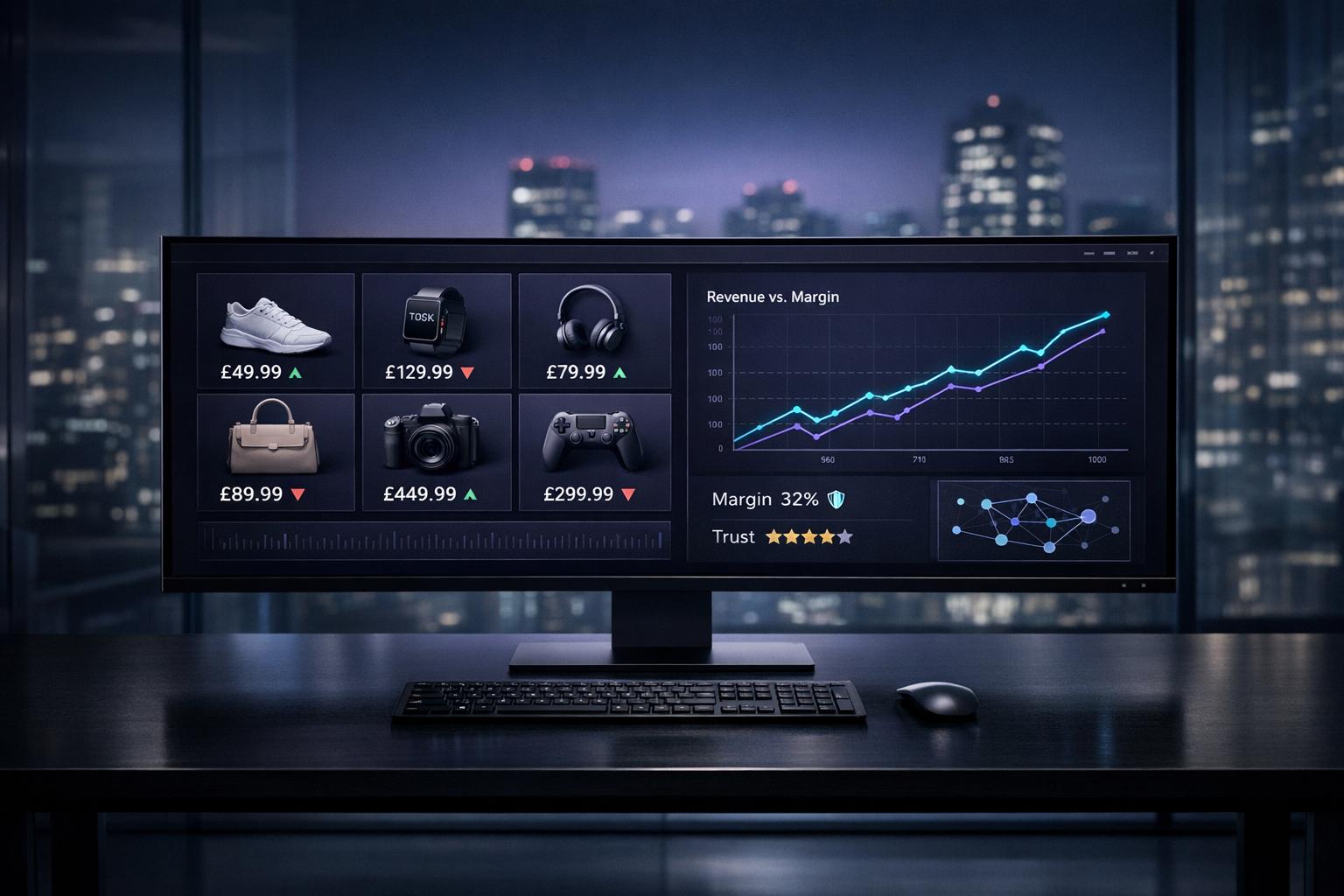
AI is transforming demand forecasting for UK SMEs by analysing a wide range of data sources, including historical sales figures, market trends, supplier lead times, and even social media activity. By uncovering patterns that manual analysis might overlook, AI delivers predictions that are both more accurate and dependable. This allows businesses to sidestep the pitfalls of overstocking or running out of stock, while also enabling smarter decisions about inventory management, pricing, and promotions.
However, it’s not just about accuracy. AI also saves time and money by automating labour-intensive forecasting tasks, cutting routine workloads by as much as 30%. With better forecasts, businesses can reduce inventory holding costs, minimise waste, and implement dynamic pricing strategies to boost revenue. Many SMEs using AI-powered tools report quicker decision-making, fewer mistakes, and a return on investment exceeding 50% within the first year.
Wingenious.ai offers tailored AI solutions specifically designed for UK SMEs, making it easier for smaller businesses to tap into these advantages without the hefty price tag or complexity of large-scale systems.
Want to apply this to your UK SME?
Start with the AI Readiness Audit, £2,450, 5 days, 50% credit against any subsequent engagement. Or book a 30-min call to talk it through with Gary.

Make this real in your business.
The Wingenious Readiness Audit turns posts like this into a five-day, twenty-page, signed-off roadmap for your SME.