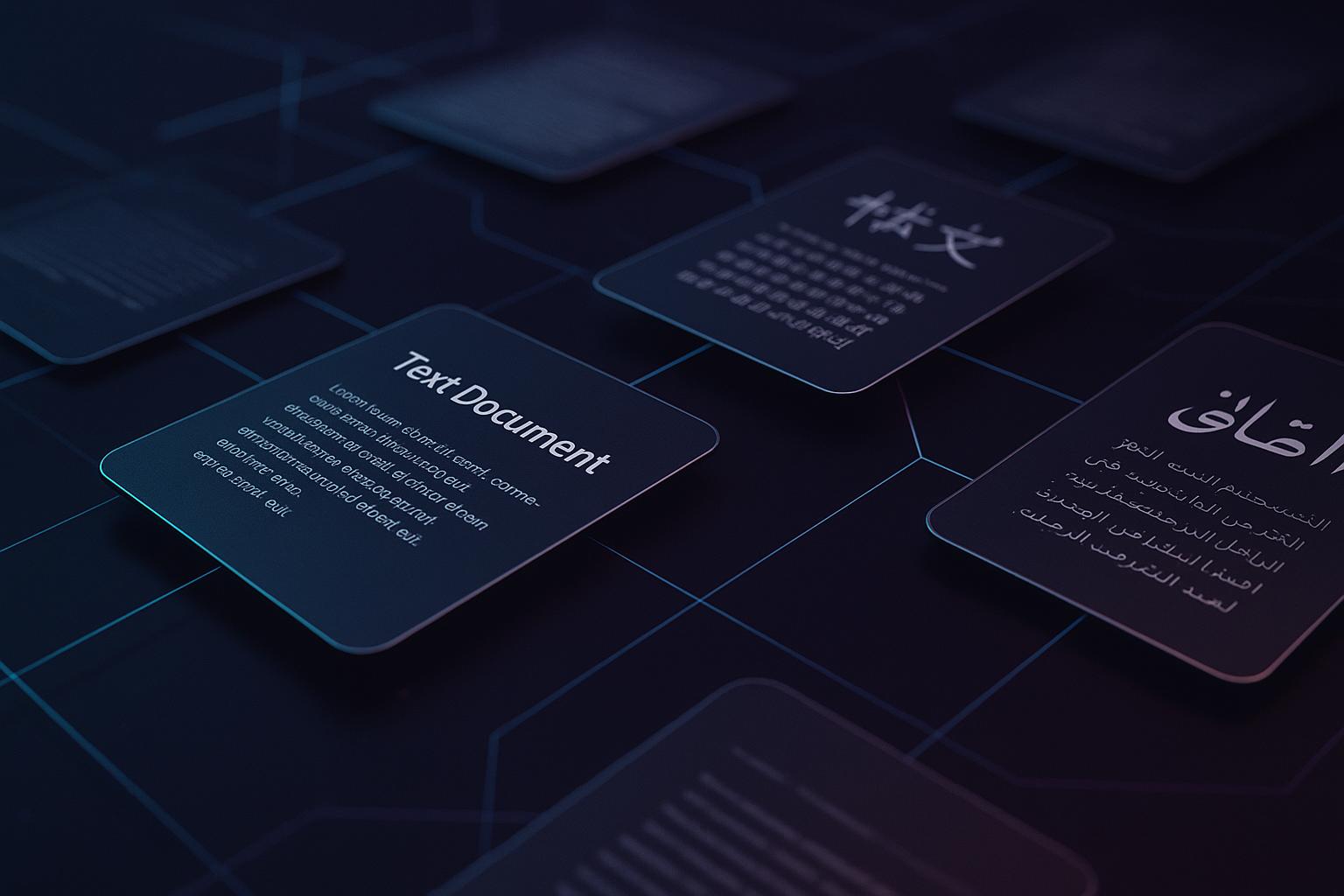
Multilingual OCR (Optical Character Recognition) is transforming how small and medium-sized enterprises (SMEs) handle multilingual documents. By automating text extraction from scanned files, images, or PDFs in multiple languages, this technology saves time, reduces costs, and improves accuracy. Here's what it offers:
SMEs using multilingual OCR report up to a 60% improvement in efficiency within six months. Whether you're managing invoices in French or contracts in Mandarin, this tool can help streamline your processes and support business growth.
One of the biggest benefits of multilingual OCR is how much faster it makes processing documents. For small and medium-sized enterprises (SMEs), manually handling documents like a German invoice or a Spanish contract can take hours - especially when translation or verification is required. Multilingual OCR changes the game by extracting text from documents in various languages in just minutes.
Take GreenLeaf Food Suppliers, for example. In 2024, this small business incorporated Tesseract OCR into its operations to digitise hundreds of paper invoices every month. The outcome? They slashed processing time by 30% and reduced costs by 20%, freeing up resources to focus on growth. This kind of efficiency doesn’t just improve individual tasks; it transforms the entire document workflow.
"Creative, ingenious and highly effective CRM automations have recovered time spent on mundane tasks allowing my team to focus on sourcing and converting leads." - Briana Jones, Sales Manager
But the speed boost doesn’t stop there. Multilingual OCR can automatically sort, index, and archive documents, no matter the language. This eliminates delays caused by foreign-language documents needing specialist attention. Instead of sitting in a queue waiting for translation, documents move smoothly through the system.
Another example of this technology in action is LocalMart, a rural retail chain. In 2025, they started using edge OCR on handheld devices to process inventory labels. This not only saved them 25% on data transmission costs but also allowed for real-time updates, even in areas with unreliable internet connections. It’s a clear demonstration of how OCR can streamline operations, even in challenging conditions.
When integrated with accounting or CRM software, multilingual OCR takes things a step further by automatically populating systems. This eliminates the need for manual data entry, speeding up processes like approvals, onboarding, and compliance.
Thanks to its ability to handle complex layouts, handwritten notes, and multiple languages, staff no longer need to pre-sort documents by language or complexity. For SMEs dealing with international suppliers or customers, this is a game-changer. Multilingual OCR processes incoming documents instantly, clearing backlogs and removing the need for specialised language skills.
Manual data entry often comes with a high risk of mistakes, especially when dealing with documents in multiple languages or unfamiliar character sets. A single typo in an invoice or a misinterpreted character in a contract can lead to costly errors that disrupt entire business operations. Multilingual OCR technology addresses this by automatically extracting and converting text from documents into editable digital formats with a high degree of precision.
Thanks to AI-powered recognition engines, this technology significantly reduces text recognition errors, even when working with low-quality scans or handwritten documents. Unlike older OCR systems that struggle with complex layouts or mixed-language content, modern multilingual OCR leverages deep learning techniques to deliver more accurate results over time.
For SMEs collaborating with international suppliers or customers, this improved accuracy is a game-changer. Documents that combine Latin characters with non-Latin scripts - like invoices featuring both English and Arabic or contracts mixing English and Chinese - are no longer a challenge. Multilingual OCR can seamlessly handle these hybrid character sets, ensuring consistent and reliable data extraction regardless of the document's linguistic complexity. This level of precision can drive meaningful improvements in operational efficiency.
"Automate routine workflows with AI solutions. Increase productivity, reduce manual errors, and scale your operations with intelligent decision-making capabilities that adapt to changing business needs." - Wingenious
The technology also shines in its ability to interpret handwritten notes and manage complex document structures, further reducing the error rate compared to manual processing. No more squinting at unclear handwriting or puzzling over unconventional layouts - AI takes care of these challenges while maintaining high accuracy standards. For SMEs, this means more dependable data for invoicing, contracts, and customer records, which boosts reliability across accounting and CRM systems.
To fully benefit from these accuracy improvements, SMEs should regularly monitor the system’s performance and fine-tune it as needed. This ensures the sustained precision that makes multilingual OCR an indispensable tool for businesses.
Multilingual OCR doesn't just enhance speed and accuracy - it also brings significant cost savings and smarter resource use. By automating manual data entry, businesses can eliminate the need for employees to spend countless hours transcribing multilingual documents. As document volumes grow, this task becomes increasingly costly, making automation a game-changer for reducing labour expenses. Beyond that, it helps cut down on related costs, such as those tied to document handling and processing.
Take GreenLeaf Food Suppliers, for example. After implementing Tesseract OCR, they achieved a 20% reduction in operational costs. This shift allowed their team to focus on strategic initiatives, while the system effortlessly managed hundreds of multilingual invoices. It’s a clear example of how automation can free up valuable human resources for more impactful work.
The savings don’t stop at labour costs. Businesses can also reduce overheads tied to document storage, printing, and photocopying. By converting paper documents into searchable digital archives, companies can cut down on physical storage needs, freeing up office space and lowering maintenance expenses - all while keeping records easily accessible.
With multilingual OCR, organisations can also rethink how they allocate resources. Instead of maintaining separate teams for each language, a single OCR solution can handle complex layouts and multiple languages at once. For instance, a small accounting firm processing hundreds of invoices monthly can now automate the digitisation and organisation of these documents. This not only speeds up auditing and reporting but also lightens the load on finance teams.
Scalability is another key advantage, especially for growing SMEs. As document volumes increase, businesses don’t need to hire more staff to keep up. This allows companies to expand operations - both locally and internationally - without a proportional rise in costs. For SMEs operating across borders, multilingual OCR eliminates the need for expensive multilingual staff or external translation services, ensuring accurate processing at a fraction of the cost.
For budget-conscious businesses, there are plenty of affordable options to get started. Open-source tools like Tesseract and OCRmyPDF offer robust functionality with minimal investment, while cloud-based platforms provide flexibility without requiring heavy upfront costs. Starting with open-source solutions is a smart, low-risk way to evaluate needs before committing to more advanced systems, ensuring cost-effective implementation from the outset.
Multilingual OCR technology is a game-changer for small and medium-sized enterprises (SMEs) looking to expand internationally. By addressing language barriers and simplifying document management, it turns what was once a major hurdle into a manageable process, making global growth far more accessible.
Modern multilingual OCR systems automatically detect and process text in various languages without requiring manual input. Imagine a UK-based SME handling invoices from French suppliers, contracts from German partners, and compliance documents from Spanish clients - all through a single automated system. This eliminates the need for costly multilingual staff or external translation services, making international operations far more cost-effective. Plus, as your business grows, these systems scale effortlessly to meet increasing demands.
Scalability is a crucial benefit here. Whether you're dealing with a handful of documents or a rapidly increasing volume, OCR technology adapts without requiring additional investment. In fact, 60% of SMEs that adopted affordable OCR solutions reported noticeable improvements in operational efficiency within just six months. This proves that even smaller businesses can achieve efficiency gains without breaking the bank.
One standout feature of modern multilingual OCR is its ability to process documents containing multiple languages. For example, a single contract written in English, French, and German can be automatically recognised and processed without the user having to define language boundaries manually. This is a huge advantage for businesses working in multilingual environments.
Cloud-based OCR solutions add another layer of flexibility. They offer on-demand processing and can integrate seamlessly with ERP, CRM, or accounting software. This means data can be automatically extracted and fed into your existing systems, ensuring smooth workflows across international operations.
Beyond improving workflows, multilingual OCR also creates searchable digital archives. This makes it easy to retrieve records in any language, allowing businesses to provide faster and more tailored support for international clients. On the compliance side, the technology simplifies managing documents like GDPR policies, tax records, and employment contracts across different jurisdictions. Instead of juggling separate processes, businesses can handle all of this in one streamlined system, saving time and reducing errors.
Perhaps the best part? Multilingual OCR enables international expansion without requiring a hefty upfront investment. With affordable open-source options and scalable cloud-based platforms, SMEs can position themselves for growth while staying competitive in an increasingly globalised digital market.
Navigating the maze of regulations while safeguarding sensitive data becomes even trickier when handling documents in multiple languages. This is where multilingual OCR steps in, turning what could be a daunting task into something far more manageable. For SMEs, it helps ensure compliance with regulations across various jurisdictions while streamlining data protection.
Switching from physical to digital storage offers a significant leap in security. By converting paper-based or image-based documents into secure, searchable digital formats, businesses can minimise risks like data loss, unauthorised access, and tampering. Digital documents benefit from encryption, controlled access, and regular backups, which together reduce the likelihood of human errors in document handling.
For UK businesses operating on a global scale, this technology is a game-changer. Whether it's processing invoices from European suppliers, managing contracts with Asian partners, or handling compliance forms for American clients, multilingual OCR ensures these documents are securely processed and stored. Take, for instance, an SME in the import/export sector that digitises customs forms and shipping documents in numerous languages - all while maintaining comprehensive audit trails.
Automation plays a crucial role here, reducing human error by up to 80% by cutting down on manual data entry mistakes and misfiling. This not only prevents compliance breaches but also supports smoother audits. Accurate, complete, and consistently formatted records are vital during regulatory inspections. These improvements in compliance and security add to the overall operational efficiency offered by multilingual OCR.
UK-specific regulations, such as the GDPR and the Data Protection Act 2018, become far easier to manage with multilingual OCR. By digitising and securely storing multilingual documents, businesses can protect sensitive information while ensuring it remains accessible for audits and regulatory checks. Automated processes also support compliance by maintaining high standards for data accuracy, access control, and record retention.
| Compliance Aspect | Manual Processing | Multilingual OCR |
|---|---|---|
| Error Rate | High | Low (up to 80% reduction) |
| Audit Trail | Limited or missing | Automated and searchable |
| Data Security | Vulnerable to breaches | Enhanced with encryption |
| Regulatory Risk | Elevated | Minimized through automation |
Cloud-based OCR solutions take things a step further by offering additional compliance benefits. These platforms often come with certifications like ISO 27001 or UK Cyber Essentials, providing robust encryption and strict access controls that meet today’s data protection standards. Detailed logs of document access create the kind of audit trails regulators expect, ensuring nothing is overlooked.
Beyond bolstering security, digitisation also reduces manual errors and compliance risks, which in turn lowers costs. With fewer mistakes, businesses can avoid costly fines and minimise the time spent on regulatory fixes.
For SMEs looking to create customised, compliant workflows, consulting with experts like Wingenious.ai can be invaluable. Agencies like these provide tailored guidance on training and workflow development, helping businesses achieve compliance without the complexity of integrating enterprise systems. You can explore their services here: Wingenious.ai.
The five benefits discussed earlier offer a solid foundation for SMEs to rethink how they handle document processing. Multilingual OCR transforms traditional workflows, enabling faster processing, improved accuracy, reduced costs, smoother international operations, and better compliance management.
Real-world examples from UK SMEs highlight measurable time and cost savings achieved through automated document processing. These gains reduce operational delays, cut down on manual errors, and free up resources for more strategic initiatives.
But the advantages of multilingual OCR go beyond efficiency. It simplifies global expansion by removing language barriers, eliminating the need for costly translation services or specialised staff. Compliance and data protection benefits are equally compelling, helping SMEs meet regulatory requirements such as GDPR and the Data Protection Act 2018. Automated, searchable digital archives make audits and compliance processes far less burdensome.
Research supports these claims: 60% of SMEs adopting cost-effective OCR solutions report improved operational efficiency within six months. Even organisations with limited resources have seen notable gains from digitised archives.
For SMEs considering this technology, the next steps involve assessing current document workflows, experimenting with open-source tools to explore capabilities, and scaling up as their needs evolve.
Multilingual OCR is more than just a tech upgrade - it’s a strategic move towards greater efficiency, lower costs, and a stronger position in the global marketplace. As AI and machine learning technologies continue to advance, these solutions will only become more accurate and capable, making early adoption a smart choice for forward-thinking businesses.
For SMEs aiming to compete on a global scale, multilingual OCR is a game-changer. With its ability to save time, cut costs, improve accuracy, support international growth, and simplify compliance, this technology paves the way for operational success and long-term growth in an increasingly competitive world.
Multilingual OCR (Optical Character Recognition) is a game-changer for SMEs expanding into international markets. By extracting text accurately from documents in various languages, it helps businesses save time, cut down on manual work, and operate more efficiently.
Here’s how it helps:
For SMEs, integrating multilingual OCR into their processes can simplify operations, freeing up teams to focus on strategic growth rather than routine admin. It’s a must-have tool for navigating the complexities of global markets.
Integrating multilingual OCR into your SME's workflows doesn't have to be complicated. Start by pinpointing the types of documents you handle most often - think invoices, contracts, or customer forms - and focus on those that would gain the most from OCR. Then, select an OCR tool that supports the languages you frequently encounter and ensure it works seamlessly with your current systems.
Once you've chosen a tool, run a small-scale test to check its accuracy and usability. It's also a good idea to train your team so they understand how to use the software effectively, and set up clear processes for handling documents. Keep an eye on how well the implementation is working by measuring things like time saved, accuracy rates, and cost savings. Use this feedback to fine-tune the system for even better performance.
Multilingual OCR technology has come a long way, now excelling at processing even the trickiest document layouts. It can handle tables, columns, and unconventional formats with impressive precision. That said, when it comes to handwritten text, the results can vary - largely depending on the quality of the handwriting and the capabilities of the OCR system.
To achieve the best possible accuracy, pairing multilingual OCR with pre-processing techniques like image enhancement can make a big difference. While printed text tends to deliver more reliable outcomes, today’s advanced OCR systems are steadily improving their ability to interpret handwritten content effectively as well.

Our mission is to empower businesses with cutting-edge AI technologies that enhance performance, streamline operations, and drive growth. We believe in the transformative potential of AI and are dedicated to making it accessible to businesses of all sizes, across all industries.


