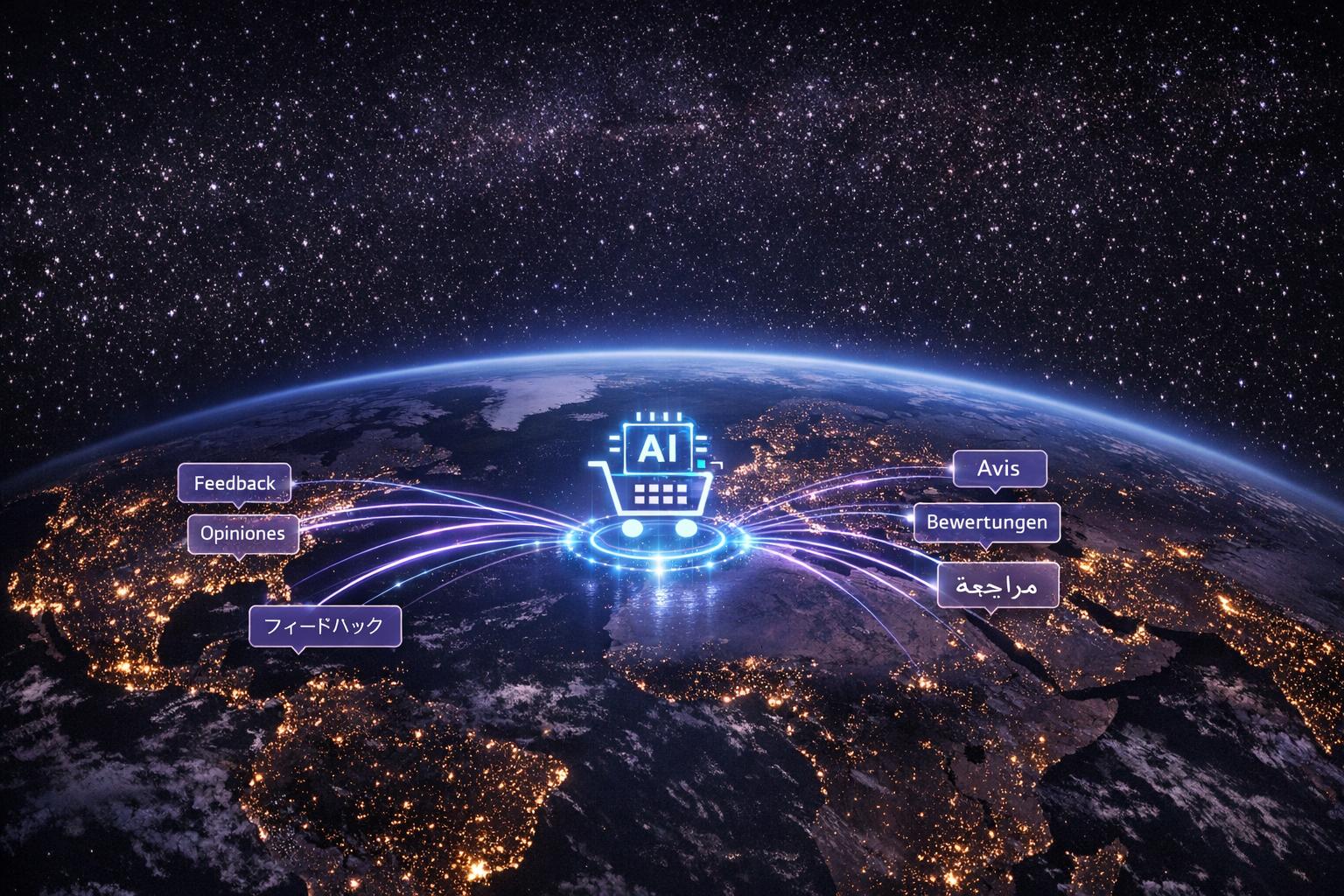
Struggling with customer feedback in multiple languages? You're not alone. Managing multilingual feedback is a major challenge for ecommerce businesses, especially SMEs. Here's the solution: AI-powered tools. They can translate, analyse sentiment, and centralise feedback across languages - quickly and affordably.
Key highlights:
Bottom line: AI makes multilingual feedback manageable, affordable, and effective for SMEs. Whether you're handling product reviews or support tickets, it's the smarter way to understand and engage your international customers.
Ecommerce SMEs often struggle with multilingual feedback management, facing hurdles like translation delays, sentiment analysis inconsistencies, and the high costs of multilingual support.
Manual translation is a costly and slow process that many SMEs simply can't afford. At around £0.22 per word, translating large volumes of content - like product descriptions for 1,000 items into 27 languages - can exceed £900,000. For small businesses, this makes scaling to global markets an unrealistic goal.
Time adds another layer of difficulty. As Mopinion highlights:
Manually translating the feedback is impossible if you're working with a time crunch.
Waiting days or weeks for translations delays customer responses and leaves issues unresolved. AI translation tools, while faster, often produce inconsistent results, making it difficult to rely on them for accurate feedback or sentiment interpretation.
Understanding customer sentiment is key for decision-making, but language and cultural differences can complicate this. For example, a Japanese five-star review might use formal phrasing that translates as neutral, while American slang could confuse AI tools entirely.
This has real consequences: 29% of customers will switch brands if support isn’t available in their native language. Misinterpreted sentiment can lead to poor customer service outcomes. For instance, if frustration in a German support ticket goes undetected by AI, it may not reach a human agent in time, risking customer loss. Current AI translation tools only achieve 70–85% accuracy, compared to the 95–100% accuracy of human translators, leaving a significant margin for error. Misunderstandings not only frustrate customers but also inflate operational costs as businesses attempt to fix these issues.
Providing multilingual support is an expensive undertaking. On average, human-led support costs £3.10 per contact, and this doesn’t include the added expense of hiring multilingual staff or outsourcing to specialised agencies. For SMEs, this often means either limiting their audience to English speakers - excluding over 75% of the global internet audience - or investing heavily in infrastructure to support multiple languages.
The costs don’t stop there. Every update to policies or help articles requires translation across all supported languages. Without this consistency, customers may receive conflicting information, leading to legal risks and potential damage to the brand’s reputation. These challenges highlight why manual processes are unsustainable, making AI ecommerce solutions an attractive alternative for many SMEs.
AI is reshaping how businesses handle multilingual feedback by automating tasks like language detection, translation, and sentiment analysis. What used to be a time-consuming and expensive process is now efficient and accessible, even for smaller businesses. Many companies begin this transition by identifying high-impact use cases in AI strategy workshops.
AI-powered tools, using Natural Language Processing (NLP), can instantly detect a customer's language from over 100 options. Once identified, these platforms employ translation engines such as Google Translate, DeepL, OpenAI, and Gemini. By combining outputs from multiple engines, they ensure translations sound natural and fit the context. This approach helps maintain cultural nuances and avoids awkward phrasing.
For example, in July 2025, an ecommerce client using the Ovesio platform translated a catalogue of 9,000 products into 27 languages for just $8,000 (around £6,400). If done manually, the cost would have exceeded $1.17 million (approximately £940,000).
AI’s capabilities extend beyond text. It can translate text within images, adjust video captions for different regions, and even provide real-time voice translation during customer interactions. To ensure quality, systems like "AI Inspectors" review translations for grammar and fluency, flagging any issues for human oversight.
But translation is just one piece of the puzzle. AI also helps interpret customer feedback with a deeper understanding of sentiment.
Accurate translations are vital, but understanding the emotions and intent behind feedback is equally important. AI uses NLP and machine learning to identify sentiment, even when feedback includes idioms or region-specific expressions. By mapping words from different languages into a shared vector space, AI can apply sentiment analysis techniques across languages, even those with limited data.
Advanced systems go a step further by analysing cultural sensitivities. This ensures that brands avoid missteps that could harm their reputation. As Hypotenuse AI explains:
"AI localization... goes beyond basic translation to adjust tone, phrasing, and product details - helping brands scale faster and deliver experiences that feel local".
The most effective strategy combines AI’s scalability with human input for fine-tuning. This ensures that the 75% of shoppers who prefer content in their native language receive messaging that aligns with their cultural expectations.
AI doesn’t just translate and analyse feedback - it also centralises it. By unifying feedback from web, mobile, and social media channels, businesses can ensure a consistent customer experience. AI systems automatically detect the customer’s language across all platforms and sync with ecommerce tools like Shopify to incorporate order and shipping details into feedback handling.
This seamless integration keeps the context intact, even when a customer switches from a website chat to a mobile app. The entire interface is localised, offering a native experience with personalised product recommendations. Brands that provide consistent multilingual support see a 33% boost in customer loyalty, and 74% of consumers are more likely to return if post-sales support is available in their native language.
For SMEs, this unified approach replaces fragmented, channel-specific processes. By leveraging AI, businesses can achieve up to 1,300% ROI in ecommerce through reduced missed opportunities and enhanced customer satisfaction.

AI vs Manual Multilingual Feedback Handling Comparison for Ecommerce
Building on the earlier discussion about AI strategy for multilingual feedback, comparing it directly with manual handling reveals some clear advantages. For ecommerce SMEs, the benefits of AI over manual methods become evident across several key areas.
Response time is where AI truly stands out. While manual handling can take hours or even days, AI processes feedback in mere seconds - averaging just 14 seconds per query - and operates 24/7. This is particularly important given that over 60% of ecommerce purchases happen outside regular business hours.
Cost per query is another area where AI shines. Manual handling often requires multilingual staff, which can be costly, especially at scale. AI automation, on the other hand, is around 25% cheaper than traditional phone support. A great example of this is Jackpots.ch, which managed to maintain its existing support team size during a pandemic surge by using AI across four languages (English, German, French, and Italian). This approach saved them hundreds of thousands in hiring costs. As Urs Klingler, Customer Service Manager at Jackpots.ch, noted:
"With automation, Jackpots' support team headcount stayed the same, rather than having to triple in size. This saved the company hiring costs in the hundreds of thousands."
Language coverage is another area where AI outperforms manual methods. While human teams are limited by their staff's language skills, AI systems can handle dozens of languages simultaneously without breaking a sweat.
When it comes to accuracy, manual methods excel in understanding nuanced contexts, but they are prone to human error. AI, meanwhile, achieves impressive precision for technical data, with only 2.5 errors per 1,000 words.
Scalability is a challenge for manual teams, as increasing workloads often require hiring more staff. AI, however, can scale effortlessly to handle workloads equivalent to hundreds of agents.
To summarise these differences, the table below provides a quick comparison.
| Metric | Manual Feedback Handling | AI-Driven Feedback Handling |
|---|---|---|
| Response Time | Hours to days | Instant (average 14 seconds); 24/7 availability |
| Cost per Query | High; labour-intensive | Low; about 25% cheaper than phone support |
| Language Coverage | Limited by staff expertise | Supports dozens of languages |
| Accuracy | Strong for nuance but prone to human error | High for technical data (2.5 errors per 1,000 words) |
| Scalability | Limited; requires more staff as demand grows | Easily scales to handle large workloads |
| Cultural Adaptation | Relies on individual agents’ knowledge | Automated, real-time adaptation |
A hybrid approach could be the sweet spot. By allowing AI to manage high-volume, repetitive queries and FAQs, while reserving human agents for complex cases and VIP customers, businesses can achieve cost savings of 30–50% compared to fully manual setups.
For many SMEs, turning AI's potential into practical outcomes can feel overwhelming. But trying to automate everything at once often leads to poor results. Instead, a phased approach - starting with a strategic assessment, followed by pilot tests, and then scaling up - offers a much clearer path to success. This method ensures your AI implementation is both effective and manageable.
Before diving into tools, take a step back and identify your key markets and channels. Focus on high-volume international markets where delivering content in the local language is critical for conversions. For instance, if your customers expect seamless native-language support, you might need an AI solution with built-in, in-context translation capabilities. This not only reduces friction but also keeps your workflow unified. Another essential factor? Make sure the AI integrates seamlessly with your sales channels, improving accuracy by tapping into your existing data.
Once you’ve outlined your priorities, begin with pilot tests in your top non-English markets. Choose these markets based on factors like ticket volume and revenue. During the pilot phase, monitor metrics such as First Response Time (FRT), resolution time, and Customer Satisfaction (CSAT) scores, broken down by language and region. For example, one home goods retailer managed over 2,000 monthly support tickets while maintaining customer satisfaction scores above 90% across several European countries. Keep an eye on time, cost, and quality to ensure minimal need for human rework. To maintain quality, set confidence thresholds - if the AI's confidence dips below, say, 80%, route the feedback to a human reviewer.
When your pilot tests show that the AI effectively handles multilingual feedback, it’s time to scale up. Use human-in-the-loop (RLHF) processes and involve subject matter experts to fine-tune AI responses, making sure they align with local cultural expectations and your brand's tone. You can also implement Retrieval-Augmented Generation (RAG), which ensures AI responses are based on the latest product data. This approach helps avoid inaccuracies and keeps information current as inventory and policies evolve. Need expert advice? Check out our AI Strategy Development service. With 63% of SMEs already using AI to boost cross-border trade, getting your implementation right could be the key to staying ahead of the competition - and avoiding costly mistakes.
Handling multilingual customer feedback doesn't have to be a drain on resources or a barrier to international growth. Small and medium-sized enterprises (SMEs) often grapple with translation delays, inconsistent sentiment analysis, and high costs for multilingual support. AI offers a practical and scalable way to tackle these challenges without breaking the bank.
The numbers speak for themselves: 76% of consumers prefer shopping on websites in their native language, and 74% are more likely to return if post-sales support is offered in their language. For ecommerce businesses, this translates into an impressive ROI of approximately 1,300% when implementing multilingual AI. These are hard-to-ignore figures in the competitive global market.
AI doesn’t just simplify translation and sentiment analysis - it also brings together feedback from multiple channels into one unified system. By following a step-by-step implementation plan, businesses can achieve measurable results. Start by identifying your highest-priority international markets and assessing your specific AI needs. Run pilot tests to validate the technology's performance, then scale gradually. Incorporating human oversight ensures quality and respects cultural nuances, making the solution more effective and adaptable to real-world needs.
The stakes are high: 56% of online shoppers abandon purchases if a site isn’t in their language, and over 69% of shopping carts are abandoned due to language barriers. Every delay in adopting multilingual AI could mean lost revenue. The technology is already proven to deliver results and is becoming a must-have for businesses aiming to stay competitive.
If you're ready to see how AI can transform the way you handle multilingual feedback, check out our AI Strategy Development service. It’s designed to help you create a roadmap tailored to your specific markets and channels. The real question isn’t whether to adopt AI - it’s how quickly you can implement it before your competitors gain the edge. Let Wingenious.ai guide you towards smarter, faster multilingual feedback solutions.
When deciding which feedback to translate, start with input from your most important customer groups - think regions with strong sales or areas that are strategically key to your business. Pay close attention to feedback that flags urgent problems, such as product flaws or delivery delays, so you can tackle pressing issues head-on. Additionally, AI tools can be a game-changer here. They can spot recurring patterns in feedback, helping you focus on themes that resonate across a larger audience, making your translation efforts more impactful.
To keep AI translations accurate in support scenarios, it's important to follow a structured process. This should include automatic language detection, ensuring the system identifies the correct language, and context preservation, so the meaning isn't lost during translation. Incorporating quality checks and human review for critical situations - like refunds or legal concerns - is essential.
For routine queries, automated translations can handle the workload efficiently. However, for sensitive or high-stakes issues, human oversight becomes crucial. Adding review steps and routing complex cases to human agents ensures the level of quality required for effective and reliable support.
Metrics that highlight the success of multilingual AI include greater customer satisfaction, higher conversion rates, and a notable 20% increase in e-commerce orders. Other key indicators include a reduction in translation errors, quicker response times, and stronger customer engagement.

Our mission is to empower businesses with cutting-edge AI technologies that enhance performance, streamline operations, and drive growth. We believe in the transformative potential of AI and are dedicated to making it accessible to businesses of all sizes, across all industries.


