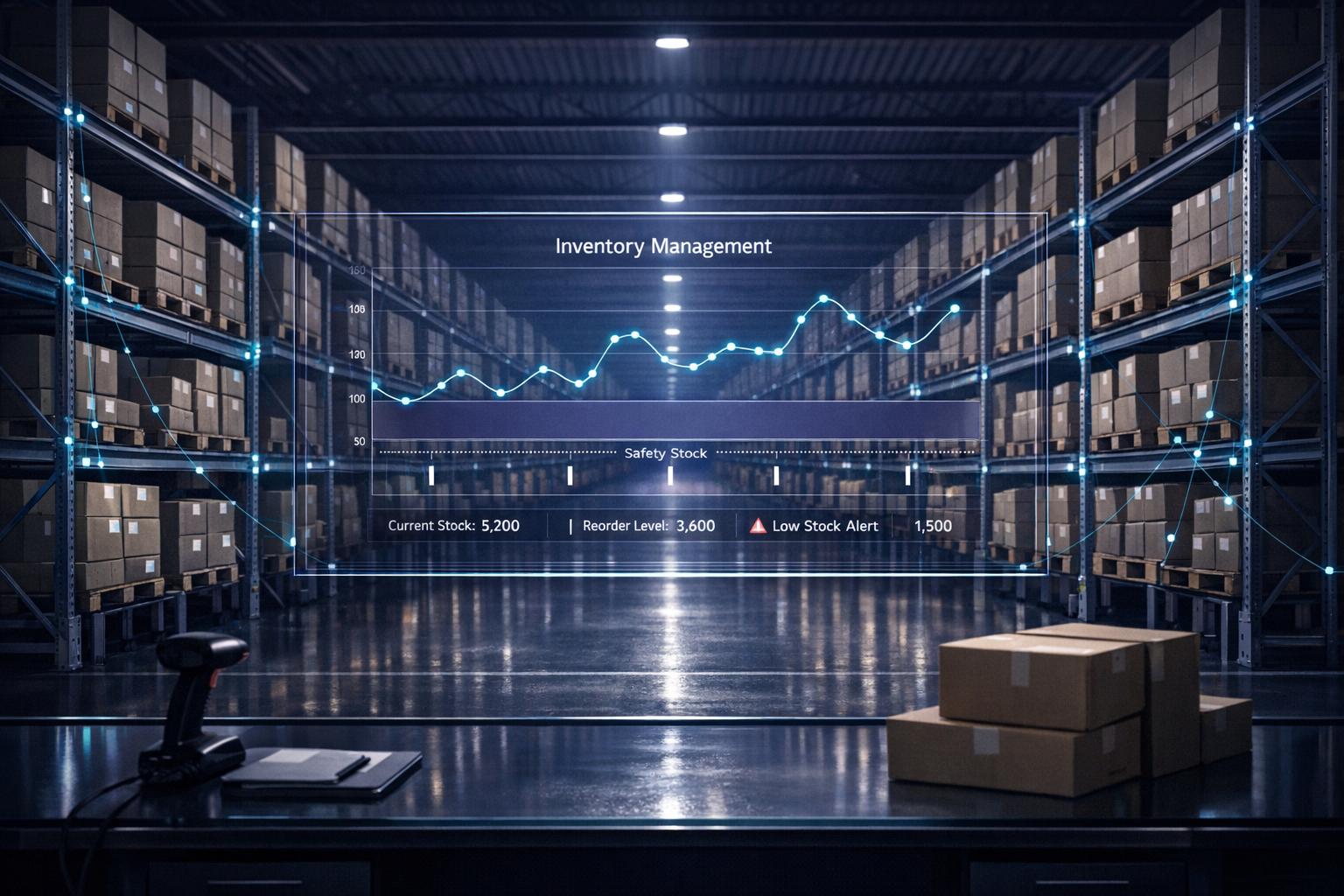
AI is changing how ecommerce businesses manage safety stock. Instead of relying on static calculations, AI uses live data to predict demand and supplier performance, helping businesses reduce stockouts and cut inventory costs.
AI-powered systems outperform manual methods by offering precise, automated, and continuous adjustments, making them ideal for scaling ecommerce businesses in competitive markets.
AI-powered safety stock planning depends on three main data categories: historical sales data, supplier performance metrics, and external market signals. Each contributes to creating a buffer that helps prevent stockouts.
The starting point for AI safety stock calculations is understanding average daily demand and its standard deviation, which reflects sales volatility. For instance, if your daily sales average 20 units with a standard deviation of 8, the AI will calculate a larger buffer compared to a product with the same average but lower variability. Setting a service level target - like 95% or 99% - enables the AI to determine the necessary buffer size using a Z-score .
To ensure accuracy, historical data needs cleaning. This means removing anomalies such as unusual viral sales spikes or one-off bulk orders. Data files should have clear column headers, consistent date formats, and a standardised approach to handling missing values. A typical analysis period might cover 3–6 months or a rolling 12-week window .
Once sales data is in order, supplier performance metrics provide further insights into lead time variability.
AI also factors in restocking times and supplier reliability. This involves not only tracking the average lead time but also its variability - how much delivery dates deviate from the promised schedule. For example, a supplier with an average lead time of 10 days and a variability of ±4 days requires a larger buffer than one with a variability of only ±1 day.
Advanced AI models use this information in a formula that captures uncertainties in both demand and supply:
Safety Stock = Z × √[(Avg LT × σ²_demand) + (Avg Demand² × σ²_LT)]
This approach has been shown to reduce stockouts by 73% and lower inventory costs by 18% compared to fixed-day buffer methods. Modern systems also rely on real-time recalibration, adjusting safety stock levels as supplier performance changes or variability crosses critical thresholds.
External market factors further enhance these calculations, making them more responsive to changing conditions.
AI expands its scope by incorporating external signals that traditional methods often miss. Seasonal changes - such as the jump in demand from Q2 to the Q4 holiday season - require dynamic adjustments to avoid stockouts during peak periods . Planned marketing campaigns and promotions can create predictable sales spikes, while unexpected events like viral social media trends may lead to sudden increases of up to 50% in daily sales, prompting the need for immediate recalculations .
The product lifecycle also plays a role. New products often need larger buffers due to higher uncertainty, while mature items stabilise and end-of-life products require reduced stock levels. Additionally, macro-environmental factors - like natural disasters, customs delays, or geopolitical events - can disrupt supplier lead times, justifying temporary increases in safety reserves. By tracking market momentum, AI helps businesses proactively adjust stock levels, balancing the risks of overstocking and stockouts.
AI has revolutionised how businesses manage safety stock, shifting from static annual reviews to dynamic, data-driven adjustments. Instead of relying on outdated rules of thumb, AI platforms integrate directly with live data streams from ecommerce systems like Shopify. This allows them to pull in real-time information, such as historical sales, purchase order histories, and lead times. With this data, AI identifies patterns - like seasonal trends, promotional surges, and emerging demand shifts - that manual methods often overlook. The process starts with solid data consolidation.
Accurate calculations depend on clean, well-organised data. AI platforms consolidate a 90-day history of sales data from multiple sources, including daily sales records, supplier delivery timelines, and product performance metrics. This data is then cleaned to remove anomalies, ensuring it reflects true demand. Proper formatting, such as clear column headers and consistent date formats, is critical here.
Once the data is prepared, the system uses ABC analysis to categorise products based on their revenue contribution. High-value "A-items" are prioritised with tighter service levels (98–99%), while slower-moving "C-items" are assigned leaner buffers (around 80–85%). This segmentation ensures that inventory levels are aligned with business priorities.
AI uses machine learning models to forecast demand more accurately than traditional methods. These models can uncover trends like seasonality and the impact of promotions. By calculating the average daily demand and its standard deviation, AI measures how much sales fluctuate around the mean. For products with irregular or "lumpy" demand, advanced systems may apply statistical distributions, such as Poisson or negative binomial models, to refine forecasts at the SKU level.
Once demand forecasts are in place, AI employs the Full Statistical Method to calculate optimal safety stock levels. This method factors in both demand variability and lead time uncertainty, using the formula:
Safety Stock = Z × √[(Average Lead Time × Variance of Demand) + (Average Demand² × Variance of Lead Time)]
The Z-score represents the service level target - for example, a 95% service level corresponds to Z = 1.65, while 99% corresponds to Z = 2.33. When supplier reliability drops or demand variability spikes, the system adjusts safety stock levels automatically. This ensures businesses are prepared for scenarios like a sudden sales surge coinciding with supplier delays.

Traditional vs AI-Powered Safety Stock Planning Comparison
When it comes to safety stock planning for ecommerce SMEs, the differences between traditional methods and AI-powered systems are striking. Traditional approaches often rely on static formulas, like maintaining a fixed 14-day buffer, with reviews conducted quarterly or even annually. In contrast, AI-powered systems use live data and predictive models to make continuous adjustments, accounting for real-time demand and supplier variability , while also enabling personalised product recommendations based on shifting consumer trends.
This distinction becomes even clearer when considering how each method handles data. Traditional methods depend on manual spreadsheet calculations, which become increasingly inefficient and prone to errors as the number of SKUs grows. They also tend to overlook practical constraints, such as Minimum Order Quantities (MOQs). On the other hand, AI platforms can integrate directly with ecommerce systems like Shopify to automate inventory management. For example, an AI-driven system once identified that high MOQs negated the need for a safety buffer, showcasing how constraint-aware planning can eliminate unnecessary stock investments.
Traditional methods also fall short during periods of rapid demand changes, such as peak seasons. They often leave businesses exposed to stockouts because they lack the flexibility to adapt quickly. AI-powered forecasting, however, anticipates these shifts, adjusting safety stock levels in advance to prevent both shortages and overstocking.
| Feature | Traditional Methods | AI-Powered Methods |
|---|---|---|
| Calculation Approach | Static formulas (e.g., fixed 14-day buffer) | Dynamic, real-time adjustments with predictive models |
| Data Processing | Historical averages; ignores trends | Live data streams, including external factors (e.g., weather, promotions) |
| Adjustment Frequency | Quarterly or annual reviews | Continuous daily recalculations |
| Accuracy | Often overestimates stock | Optimised through real-time risk simulations |
| Stockout Reduction | Baseline performance | 40–60% reduction in stockout frequency |
| Inventory Investment | Higher due to excessive buffers | 15–25% lower total inventory costs |
| Operational Effort | High manual effort (spreadsheets, errors) | Low; automated through integrated platforms |
| Constraint Handling | Ignores MOQs and lot sizes | Considers MOQs, supplier reliability, and lead times |
The advantages of AI-driven safety stock planning are clear. Businesses using these methods have reported a 40–60% drop in stockout frequency and a 15–25% reduction in inventory costs. Take the example of a mid-sized ecommerce retailer managing 2,800 SKUs: they reduced their stockout rate from 8.3% to 2.2% and cut their average inventory value from £847,000 to £695,000. This not only saved them £38,000 in annual carrying costs but also prevented an estimated £145,000 in lost sales. These results underscore why AI-powered systems are emerging as a smarter, more efficient choice for inventory management in modern ecommerce.
Implementing AI-driven safety stock planning successfully hinges on aligning your systems with key business goals, integrating data across all sales channels, and staying vigilant as market dynamics evolve. Here’s how to approach it effectively.
Start by using ABC analysis to prioritise your inventory based on revenue impact. For instance, aim for higher service levels (98%) for your top-revenue A-items, while accepting occasional stockouts on lower-value C-items (85%). This approach frees up capital to focus on more profitable inventory. Considering that 41% of shoppers are likely to switch brands if their preferred item is unavailable, safeguarding your top sellers is essential.
While AI is excellent at spotting patterns, it’s important to pair it with human judgement. For scenarios like launching a new product, expanding into critical sales channels like Amazon, or managing unexpected supplier disruptions, you’ll need to step in and override or adjust AI recommendations. These are areas where the model might lack the broader business perspective.
If your business spans platforms like Amazon, TikTok Shop, and Shopify, your AI system must consolidate inventory data into a single source of truth. Achieving this requires integrating your ecommerce platforms (e.g., Shopify, WooCommerce), warehouse management systems (e.g., ShipBob, ShipStation), and supplier portals for inbound tracking. Without this integration, businesses can lose over 20 hours weekly to manual data reconciliation.
Create a central data layer that pulls real-time information from all these systems. However, don’t treat all platforms the same - sales velocity can vary significantly between them. For example, demand on Amazon may differ from Shopify. Your AI system should forecast demand separately for each channel before combining data for reordering. As OpsClaw.ai explains:
Your Amazon velocity is different from your Shopify velocity. Forecast per channel, aggregate for reordering.
Begin with high-risk or high-volume SKUs before rolling out AI integration across all categories. To maintain control, give your AI system read-only access to sales and warehouse data while setting financial thresholds for automated ordering. For instance, auto-approve orders under £500 but require human review for those exceeding £2,000.
Once integration is in place, ongoing review is vital to ensure the system runs smoothly.
AI systems need continuous oversight to stay effective. For products with high variability or new launches, monitor performance weekly or even daily. Stable items, on the other hand, may only need quarterly reviews. Set automated alerts to flag SKUs for immediate attention if service levels drop below a certain point or if lead times become unpredictable. Tociny.ai advises:
Treating your safety stock as a 'set-it-and-forget-it' number is a classic mistake. Things change too fast for that.
Regularly audit your data quality to avoid issues where poor input leads to unreliable outputs. Ensure consistency in column headers, date formats, and numerical values across platforms like Amazon and TikTok Shop. Companies using advanced inventory analytics often achieve a 15–25% reduction in total inventory costs while maintaining or improving service levels, but this only works if the data is accurate and up to date.
AI-powered safety stock planning is reshaping how ecommerce businesses handle inventory. Instead of relying on reactive guesswork, it brings predictive accuracy into the mix. By incorporating factors like weather changes and promotional events, it sharpens forecasting precision. It also helps free up cash tied in overstock and lowers operational costs by reducing dependency on spreadsheets and last-minute shipments. Considering that 69% of shoppers may switch brands after encountering just one stockout, ensuring product availability is critical for protecting both your reputation and revenue.
To get started, focus on clean, standardised data and a clear implementation plan. Begin with the top 20% of your 'A' items - the ones driving 80% of your revenue. Ensure your historical sales data is properly formatted before feeding it into AI systems. As Josh Pitman, Managing Director at Priory Direct, points out:
Quality data is the key that underlies any process involving AI technologies. Poor data will yield poor results in any context where AI is applied.
For best results, update safety stock levels monthly for fast-moving items and quarterly for slower ones. Make immediate adjustments when suppliers change or during major campaigns. These steps are a solid foundation for improving inventory efficiency.
Switching to AI-driven inventory management offers a range of benefits. Moving away from static spreadsheets to dynamic AI systems can cut total inventory by 20–25% while maintaining a 97% service level. This is achieved through statistical models that account for demand and lead time variability. AI also scales effortlessly across thousands of SKUs, adapting daily to real-time data from platforms like Shopify. This evolution from static to dynamic planning helps ecommerce businesses shift from reactive management to a predictive approach that anticipates trends, seasonality, and market changes.
Take the leap into intelligent automation with Wingenious Stock Management services. They provide tailored consultancy to help UK-based SMEs adopt AI-driven safety stock planning. These solutions integrate seamlessly with existing platforms, ensuring high-quality data and delivering measurable results in just 3–6 months. Additionally, UK businesses can explore funding opportunities through Knowledge Transfer Partnership (KTP) schemes or the BridgeAI programme.
To get started with AI safety stock planning, it's crucial to collect precise data. Focus on key areas like historical sales, supplier lead times, stockout records, and any external factors that influence demand. Pay special attention to patterns of demand variability, unexpected spikes, and supply chain disruptions.
Key metrics to track include the average and maximum lead times and daily usage rates. Reliable data forms the backbone of accurate forecasts, helping to minimise stockouts while maintaining well-balanced inventory levels.
To determine the best service level for each SKU, you need to balance keeping customers happy with managing inventory costs effectively. Start by assessing how important the SKU is to your customers - some items are more critical than others. Then, weigh the cost of holding extra stock against the risk of running out. Use statistical tools to set a target service level, taking into account factors like demand fluctuations and lead times. Keep an eye on performance regularly and tweak service levels when necessary to keep inventory efficient while meeting customer needs.
AI-driven safety stock planning can bring noticeable benefits in no time. Once your data is synced, certain systems can offer real-time updates and forecasts almost instantly. This means quicker stock optimisation, fewer stockouts, and improved product availability - which translates to happier customers.

Our mission is to empower businesses with cutting-edge AI technologies that enhance performance, streamline operations, and drive growth. We believe in the transformative potential of AI and are dedicated to making it accessible to businesses of all sizes, across all industries.


