
Technical debt in AI is a growing issue for UK SMEs, costing businesses resources, time, and money. Rushed AI implementations often lead to hidden issues like outdated models, messy data, and poor system maintenance. Ignoring these problems can lead to performance degradation, security risks, and higher costs over time.
Key Takeaways:
Addressing AI technical debt early can save money, improve efficiency, and prevent costly failures. Start by auditing your systems and prioritising fixes that offer the most impact with minimal effort.
Catching technical debt early can save your business a lot of trouble - and money. AI technical debt often builds up quietly, only becoming a noticeable problem when it's too late. Here are some practical ways to spot it before it spirals out of control.
The earlier you notice these red flags, the better your chances of avoiding future headaches. One major signal is velocity degradation. For instance, if a task that used to take two days now drags on for five or seven, you’re likely dealing with growing technical debt. Similarly, if developers are spending 42% of their time - about two days every week - managing this debt instead of creating new features, it’s time to take action.
Another tell-tale sign is structural entropy. This happens when naming conventions become inconsistent - think user_id, userId, and uid all referring to the same thing. If you find three or more variations like this, it’s a sign your system lacks standard protocols and has reached a critical point. File sizes can also be a clue: files over 300 lines of code suggest early-stage issues, while anything exceeding 800 lines points to deeper architectural problems.
Model performance decay is another key indicator. Unlike traditional software, machine learning models tend to degrade over time - 91% of them, in fact, as real-world data distributions shift. A model that works perfectly today might start producing errors within months, and the decline isn’t always immediately obvious.
You don’t need to invest in expensive tools right away to start tackling technical debt. Simple structural audits can go a long way. For example, you can use basic command-line scripts to count naming inconsistencies or measure your test-to-production code ratio. If this ratio drops below 30%, it’s a warning sign; if it falls under 10%, the situation is critical and needs urgent attention.
For a deeper dive, tools like the AI Chaos Index Score (£297) can provide a tailored evaluation of your AI systems, offering a risk score based on structural issues. Another useful metric is feature velocity. If the time required to develop new features increases by 50%, it’s worth investigating. A 150% increase or more signals a serious problem. Additionally, track how long it takes new developers to get up to speed. If onboarding is slow, it may mean your codebase has become overly complex and reliant on undocumented knowledge.
To see this in action, consider the challenges faced by ecommerce SMEs in the UK. Unlike high-stakes industries like manufacturing, these businesses often struggle with disorganised data pipelines. For example, customer data might be stored differently across a website, inventory system, and CRM. This fragmentation often undermines AI-powered customer support initiatives. The result? An AI chatbot might correctly identify a customer’s order history one moment but fail to do so the next. This isn’t a problem with training the AI - it’s a deeper issue rooted in structural debt that no amount of fine-tuning can resolve.
Once you've identified AI technical debt, the next step is addressing it head-on. You don't need to overhaul your entire system or spend a fortune to make progress. A structured approach combined with consistent maintenance can go a long way.
MLOps (Machine Learning Operations) forms the backbone of maintaining AI systems effectively. It introduces discipline and automation to AI workflows, helping reduce technical debt.
Start by splitting your AI pipelines into modular components. Instead of relying on a single, monolithic workflow where one change can disrupt everything, break your process into smaller modules - such as pre-processing, training, and deployment. This way, you can update individual parts without risking a system-wide failure.
Use tools like DVC and Git to track datasets, hyperparameters, and model weights. This makes it easier to roll back changes if needed. For example, if a model underperforms in production, you'll know exactly which data version caused the issue.
Automated testing is essential for catching problems early. Unlike traditional software, AI systems can fail silently - producing results that appear correct but aren't. Automated validation helps you spot issues like data integrity problems, schema changes, or performance drift before they cause larger disruptions. A great example of this is NatWest Group, which implemented an MLOps platform using Amazon SageMaker Studio in 2024. By standardising processes and automating repetitive tasks, they not only reduced technical debt but also sped up future model development.
Another important step is setting aside a budget specifically for refactoring. Experts suggest allocating 20% of your IT budget to this task, as it offers a strong return on investment. For instance, UK SMEs often see a 245% ROI with a payback period of just under five months. Regular refactoring helps prevent debt from piling up and keeps systems manageable.
With these MLOps practices in place, you'll have a solid foundation for reducing technical debt.
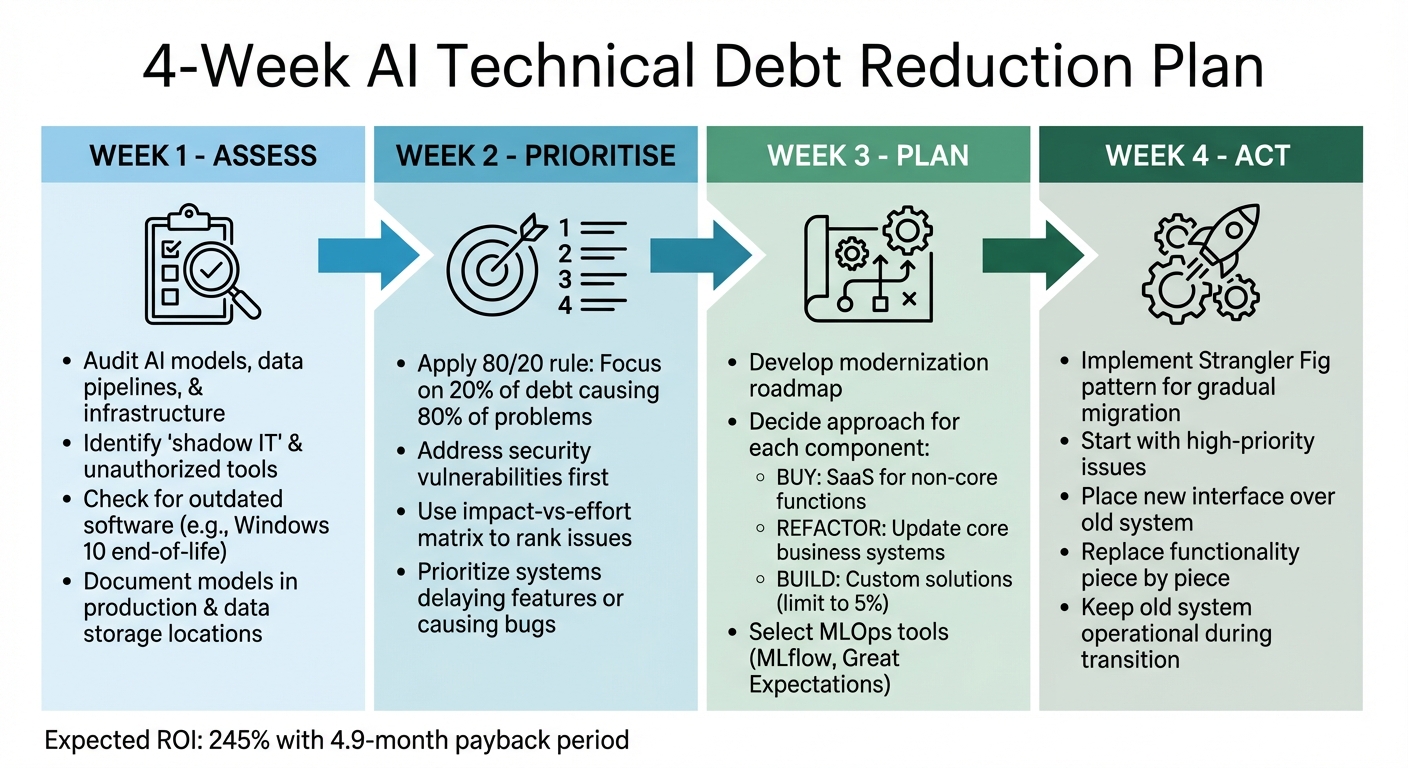
This four-week plan focuses on addressing inefficiencies and vulnerabilities while keeping costs under control.
Start by auditing your AI models, data pipelines, and infrastructure. Look for "shadow IT" - tools or systems your team uses without official approval. Also, check for outdated software, such as Windows 10, which reached its end-of-life in October 2025, leaving systems exposed to security risks. Document everything, including which models are in production, their performance, and where data is stored.
Identify the most pressing issues - typically, the 20% of debt causing 80% of your problems. Address security vulnerabilities first, followed by systems that delay new features or cause frequent bugs. Use an impact-versus-effort matrix to rank issues. For example, fixing a critical payment system security flaw might require minimal effort but have a huge impact, while minor inefficiencies in less-used tools can wait.
Develop a roadmap for modernisation. For each problematic component, decide whether to:
At this stage, choose your MLOps tools. Many small businesses prefer starting with open-source options like MLflow for experiment tracking or Great Expectations for data validation.
Use the Strangler Fig pattern to gradually migrate systems without downtime. Start with a high-priority issue, place a new interface in front of it, and slowly replace functionality piece by piece. The old system remains operational until its functionality is fully migrated and can be retired.
Week
Focus Area
Key Activities
Audit models, pipelines, and hardware; identify security gaps.
Rank issues by impact vs. effort; focus on the most critical problems.
Select MLOps tools; define steps for gradual migration.
Fix critical vulnerabilities; begin modular updates to pipelines.
By following this plan, you'll have a clear path to reducing your technical debt.
Automation is a powerful tool for managing technical debt. It eliminates repetitive inefficiencies and supports the ongoing maintenance required to keep AI systems running smoothly.
Automated testing and monitoring tools like Kubeflow and MLflow can detect performance drift and trigger retraining before issues escalate. Studies show that 91% of machine learning models experience performance degradation as real-world conditions evolve. These tools monitor your models continuously, identifying concept drift (when data patterns shift) and initiating retraining to prevent failures.
For UK SMEs, there are financial programmes and strategic news on AI to help with these efforts. The Made Smarter initiative offers match-funded grants of up to £20,000 for technology adoption. Additionally, the Help to Grow scheme provides 90% government-subsidised training (£750 per person) for leadership and digital adoption over 12 weeks. You can also claim R&D Tax Relief to cover 20–25% of qualifying costs when modernising legacy AI systems.
The cost of inaction is steep. Ignoring technical debt leads to higher expenses, security risks, and operational failures. By committing to regular maintenance, leveraging automation, and taking advantage of available support, UK SMEs can keep their AI systems efficient and ready for future growth.
Having the right tools on hand can mean the difference between technical debt spiralling out of control and keeping it under wraps. For UK SMEs, the challenge often lies not just in identifying the issues but in finding cost-effective ways to tackle them.
Static analysis tools are a great way to catch problems before they snowball into costly fixes. SonarQube, for instance, is excellent at spotting duplicated code. With duplicated code blocks in software projects increasing eightfold in 2024, this tool has become increasingly relevant. It integrates seamlessly into your CI/CD pipeline, blocking merges that fail quality checks or exceed complexity thresholds.
For SMEs with tighter budgets, DenchClaw offers a systematic approach to auditing AI technical debt. Its "Technical Debt Register" prioritises fixes based on a risk-to-effort ratio, helping teams decide where to focus their energy. It highlights issues like cyclomatic complexity (overly complex functions), dependency problems, and test coverage gaps - problems often caused by AI-generated code lacking proper architectural oversight.
Another essential tool is Snyk, which addresses dependency debt. AI coding assistants sometimes suggest outdated or unnecessary libraries, creating potential security vulnerabilities. Snyk scans for these issues and flags them before they escalate.
For businesses just starting out, simple bash scripts can be a cost-effective alternative. These can flag files exceeding 300–500 lines or identify naming inconsistencies. While not as thorough as dedicated tools, they’re a practical first step for tackling technical debt.
Static tools are great for preventing debt, but real-time monitoring tools help manage issues as they arise. MLflow, for example, is particularly useful for teams working with generative AI. It tracks bottlenecks in AI pipelines, such as failed intermediate LLM calls. Additionally, MLflow supports evaluation datasets and feedback APIs, enabling you to build "golden sets" of examples to measure the quality of AI outputs over time.
For traditional code quality, GitClear offers insights into code churn - the percentage of lines rewritten within two weeks of being written. Between 2021 and 2024, churn rates rose from 5.5% to 7.9%, largely due to AI-generated code being written hastily and frequently revised. High churn rates are a clear sign of accumulating technical debt.
Dashboards like Codacy and CodeClimate provide a visual overview of your code’s health, tracking maintainability scores and test coverage. These tools can flag issues in real-time, such as excessive code duplication or inadequate test coverage, and even set thresholds that prevent problematic code from being merged.
A practical tip: tag AI-generated commits with metadata. This allows your dashboard to compare AI-written code with human-written code, helping you spot patterns and refine your processes.
Here’s a quick comparison to help you decide which tools suit your needs best:
Tool
Category
Core Function
Best For
Static Analysis
Detecting duplication and complexity
Ensuring quality gates in CI/CD
AI-Specific Audit
Managing cyclomatic complexity and debt
Prioritising fixes by risk-to-effort
Security
Scanning for dependency vulnerabilities
Addressing security risks from AI libraries
ML Lifecycle
Pipeline tracing and evaluation datasets
Managing GenAI-specific issues
Analytics
Measuring code churn
Tracking code quality trends
Code Quality
Scoring maintainability and test coverage
Visualising overall code health
UK SMEs should start small, selecting tools that address their most pressing needs. For example, combining SonarQube for static analysis with Snyk for security scanning is a solid starting point. Once you’ve got a handle on the basics, you can expand to include tools like MLflow or GitClear for ongoing monitoring.
To help cover costs, SMEs can explore programmes like the Made Smarter initiative, which offers match-funded grants of up to £20,000 for technology adoption. Additionally, R&D Tax Relief can offset 20–25% of eligible development expenses. These options make it easier to invest in tools that help manage technical debt efficiently.
Managing technical debt is crucial for protecting your business and paving the way for growth. Developers, on average, spend 42% of their time addressing technical debt rather than creating new features - a significant cost to consider. However, taking a proactive approach to managing this debt can be just as impactful.
Reducing technical debt offers a 245% return on investment (ROI) with a payback period of just 4.9 months. Businesses that dedicate 20% of their yearly IT budget specifically to reducing this debt can effectively prevent maintenance costs from spiralling out of control.
For UK SMEs, the recommended strategy is clear:
Incorporating compliance standards, like GDPR, directly into AI interactions is another essential step. This avoids "compliance debt" and reduces the risk of legal penalties. As Ward Cunningham aptly put it:
The danger occurs when the debt is not repaid. Every minute spent on code that is not quite right for the programming task of the moment counts as interest on that debt.
By acting on these insights, UK SMEs can position themselves for long-term success.
To tackle the rising costs and risks of technical debt, begin with a simple 30-day action plan:
This step-by-step approach, inspired by the "Strangler Fig" pattern, allows you to replace outdated components gradually, avoiding the disruption of a complete overhaul.
Financial support is available to make these improvements more accessible. For instance:
If you're unsure where to start or need expert guidance, Wingenious offers consultancy services tailored for UK SMEs. Their AI Readiness Assessment can help you measure your current technical debt and build a practical roadmap for adopting sustainable AI systems. Book a strategy call to start building AI solutions that improve efficiency and drive growth - without accumulating unnecessary technical debt.
Understanding the true cost of AI technical debt means looking beyond the obvious. Hidden expenses such as inefficiencies, project delays, and repeated rework can add up quickly. You also need to factor in costs tied to outdated systems, unexpected downtime, and lost revenue caused by underperforming AI models.
To get a clearer picture, it's helpful to estimate these costs over a specific timeframe - annually, for example. This approach provides a more comprehensive view of how technical debt impacts your bottom line. Tools like ROI analysis can be incredibly useful here, as they help track performance metrics and financial outcomes. By doing so, you gain actionable insights into how to better manage and reduce AI-related technical debt.
Monitoring changes in model accuracy over time is the fastest way to spot model drift. For less critical applications, third-party AI assurance testing can be a useful tool to catch distribution drift early. This allows any performance issues to be resolved before they impact users.
To make the most of your efforts, tackle the biggest challenges first. Begin with high-friction workflows - solving just one can serve as a blueprint for future fixes. Track how data is passed between processes, assign clear responsibilities, and ensure everything aligns with regulations to avoid automation hiccups. Focus on areas that deliver fast, measurable results, like cutting down response times or trimming administrative hours. This way, you’ll stretch your resources further and see real, practical benefits.
{"@context":"https://schema.org","@type":"FAQPage","mainEntity":[{"@type":"Question","name":"How do I calculate the real cost of AI technical debt in my SME?","acceptedAnswer":{"@type":"Answer","text":"<p>Understanding the true cost of AI technical debt means looking beyond the obvious. Hidden expenses such as inefficiencies, project delays, and repeated rework can add up quickly. You also need to factor in costs tied to outdated systems, unexpected downtime, and lost revenue caused by underperforming AI models.</p> <p>To get a clearer picture, it's helpful to estimate these costs over a specific timeframe - annually, for example. This approach provides a more comprehensive view of how technical debt impacts your bottom line. Tools like ROI analysis can be incredibly useful here, as they help track performance metrics and financial outcomes. By doing so, you gain actionable insights into how to better manage and reduce AI-related technical debt.</p>"}},{"@type":"Question","name":"What’s the quickest way to spot model drift before it impacts customers?","acceptedAnswer":{"@type":"Answer","text":"<p>Monitoring changes in model accuracy over time is the fastest way to spot model drift. For less critical applications, third-party AI assurance testing can be a useful tool to catch distribution drift early. This allows any performance issues to be resolved before they impact users.</p>"}},{"@type":"Question","name":"Which fixes should I prioritise with a small budget and team?","acceptedAnswer":{"@type":"Answer","text":"<p>To make the most of your efforts, tackle the biggest challenges first. Begin with high-friction workflows - solving just one can serve as a blueprint for future fixes. Track how data is passed between processes, assign clear responsibilities, and ensure everything aligns with regulations to avoid automation hiccups. Focus on areas that deliver fast, measurable results, like cutting down response times or trimming administrative hours. This way, you’ll stretch your resources further and see real, practical benefits.</p>"}}]}

Our mission is to empower businesses with cutting-edge AI technologies that enhance performance, streamline operations, and drive growth. We believe in the transformative potential of AI and are dedicated to making it accessible to businesses of all sizes, across all industries.


