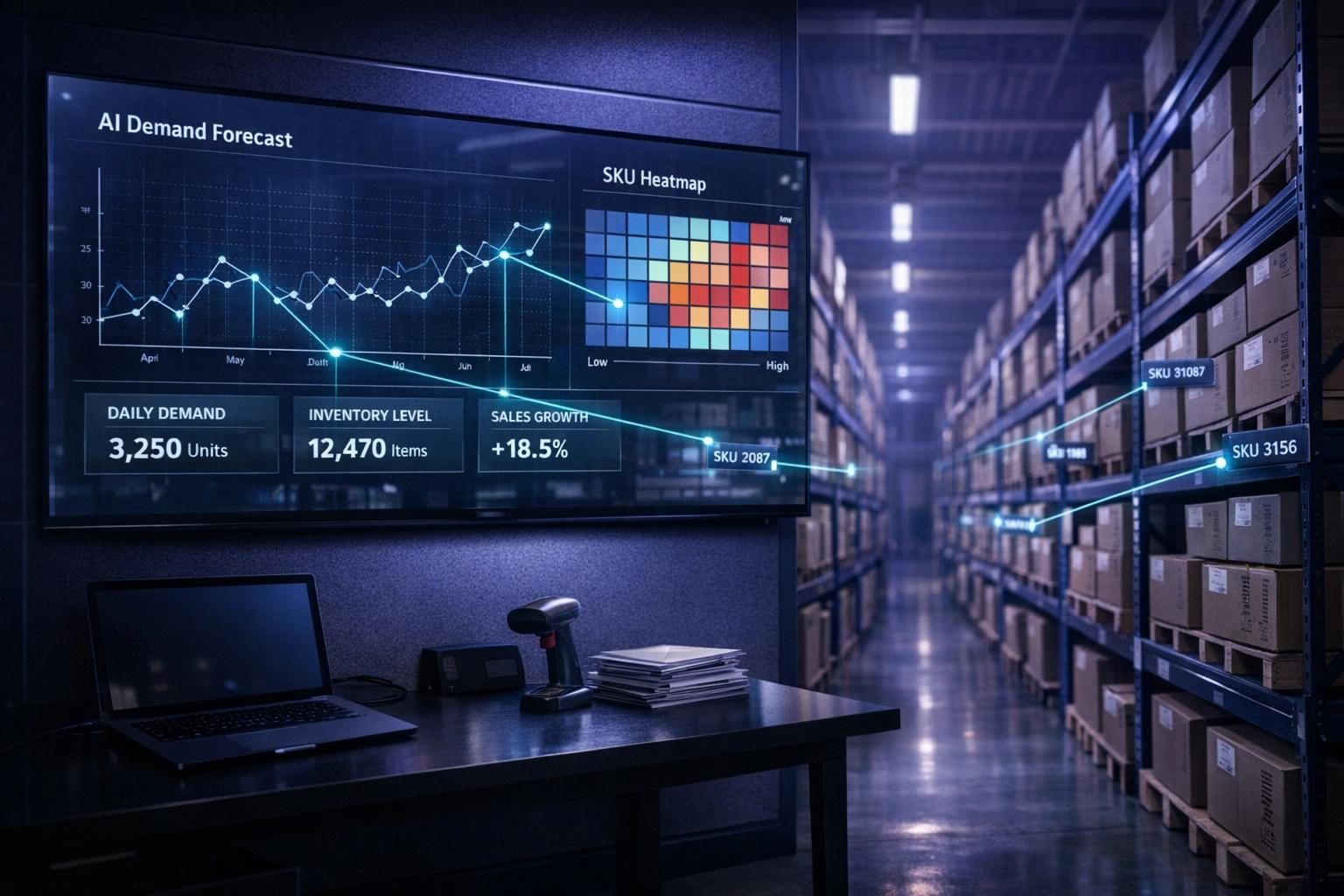
AI demand forecasting helps ecommerce businesses predict customer demand using historical and real-time data. It replaces guesswork with precise forecasts, reducing stockouts by up to 65% and cutting forecasting errors by 20%-50%. SMEs can use AI to improve AI-driven inventory management, optimise pricing, and allocate products more effectively across sales channels.
By leveraging AI, SMEs can make smarter decisions, improve revenue, and streamline operations.
AI demand forecasting takes historical and current data to predict future demand more effectively than traditional tools like spreadsheets. By blending predictive analytics, machine learning, and time-series models, it identifies patterns, tracks trends, and accounts for seasonal changes.
Alistair Williams, Founder & Lead AI Consultant at ArcMind AI, explains:
"AI considers thousands of variables simultaneously, runs the calculations every day without getting tired, and never lets optimism bias inflate the forecast."
Unlike traditional methods, which may rely on last year’s monthly sales figures by category, AI operates at a much more detailed level. It analyses data down to individual SKUs (stock-keeping units) across multiple sales channels, updating forecasts daily and incorporating subtle signals that spreadsheets simply can't handle.
AI forecasting depends on two primary data categories: internal and external.
Internal data serves as the backbone. This includes detailed sales records (ideally broken down to SKU, day, and channel), pricing and promotional history, marketing spend from platforms like Google and Meta, web activity such as page views or cart additions, and past stockout records. Importantly, AI recognises that zero sales during a stockout don't mean demand was absent, and it adjusts calculations accordingly.
External data adds context that internal data alone can't provide. Examples include UK public holidays, weather trends, Google search patterns, social media activity (like viral TikTok moments driving sudden demand), and economic indicators such as inflation or consumer confidence. These external factors help AI predict shifts in demand before they happen, rather than just reacting to past performance.
| Data Type | Examples | Role in Forecasting |
|---|---|---|
| Internal – Sales | SKU-level transaction logs, returns data | Establishes baseline demand patterns |
| Internal – Commercial | Promotions calendar, ad spend, pricing history | Differentiates promotional effects from organic demand |
| Internal – Behavioural | Page views, wishlist adds, cart abandonment | Acts as an early signal of purchase intent |
| External – Contextual | UK bank holidays, weather APIs, Google Trends | Accounts for seasonal and environmental shifts |
| External – Market | Social media trends, consumer confidence index | Reflects hype cycles and economic pressures |
With these types of data in place, AI can begin the process of turning raw information into actionable forecasts.
Once the data is collected, AI processes it through several key steps to create accurate forecasts.
"Predictive analytics does not require perfect data - it requires sufficient data." - Alistair Williams, Founder & Lead AI Consultant, ArcMind AI
This means that even small and medium-sized businesses don’t need a flawless data setup to get started. A solid history of 12 to 24 months of sales data is usually enough to capture seasonal trends and support strategic decisions.
Before diving into AI forecasting, it’s crucial to get your data in order. As LatentView Analytics points out:
"The harder work is upstream: deduplicating and reconciling data across systems before any modelling happens."
For many SMEs, data is often scattered across multiple systems, making it difficult to implement automation techniques for SMEs, creating gaps and inconsistencies. The first step is to consolidate all your data into a single dataset. Without this, your AI model is essentially working with incomplete information. Once your data is unified, it’s time to clean it up. Look out for duplicate SKUs, inconsistent product names, and gaps in the data. It’s also important to identify stockout periods and adjust the data to reflect actual demand. Properly tagging cancellations and returns helps ensure these don’t create false demand signals. As Linnworks warns:
"Sophisticated AI solutions produce confident-sounding wrong answers when trained on dirty data."
A practical way to start is by reviewing your top 10 stockout and overstock events from the past 90 days. In most cases, these issues stem from poor data quality, missing seasonal adjustments, or errors in lead time records.
Once your data is cleaned and organised, you’re ready to define your forecasting objectives.
Clean data is just the beginning. To make your forecasts meaningful, you need clear goals. Before building any model, ask yourself: what decision will this forecast influence? Without a clear purpose, you might end up with impressive-looking predictions that fail to impact your operations.
"A prediction is worthless unless it changes a decision. This is the step that separates valuable predictive analytics from expensive data science experiments." - Alistair Williams, Founder & Lead AI Consultant, ArcMind AI
Forecasting goals typically fall into two categories. Operational goals focus on short-term improvements, like enhancing SKU-level accuracy over a 12-week period to guide purchase orders. Strategic goals are more long-term, such as creating category-level projections for the next 12 months to aid in budgeting or planning for peak seasons. Tackling both types of goals with a single model from the start can complicate matters unnecessarily. Instead, prioritise the goal that delivers the most immediate financial benefit - often reducing stockouts on your top-revenue products.
It’s also wise to align your forecasting horizon with your supplier lead times. For instance, if your supplier requires six weeks to deliver, you’ll need at least a two-month forecast to manage that relationship effectively.
With your goals in place, the next step is deciding how detailed your forecasts need to be. Not every product requires the same level of precision. Applying highly detailed SKU-channel-day modelling to slow-moving items, for example, can add unnecessary complexity.
A good approach is to use ABC classification. Focus on high granularity for the top 20% of your SKUs while managing the bottom 50% with simpler forecasting rules. The table below provides guidance on how the level of detail should adjust based on your forecasting horizon:
| Forecast Horizon | Time Period | Primary Use Case | Recommended Granularity |
|---|---|---|---|
| Short-term | 1–4 weeks | Fulfilment, warehouse capacity | SKU-Day / SKU-Channel |
| Medium-term | 1–3 months | Purchase orders, cash flow | SKU-Month |
| Long-term | 3–12 months | Budgeting, peak season pre-buys | Category-Month / Brand-Quarter |
One often-overlooked area is bundles and kits. If you sell bundled products, it’s essential to track inventory at the component level rather than just the bundle level. A shortage in just one component can disrupt the fulfilment of the entire bundle.

How AI Demand Forecasting Works: 5-Step Process for Ecommerce SMEs
The first step in using AI for demand forecasting is gathering data from all relevant sources. For ecommerce businesses, this typically includes platforms like Shopify, Amazon, or eBay, alongside marketing tools such as Meta Ads and Google Ads, web analytics platforms like Google Analytics, and operational systems like warehouse management or third-party logistics providers. Interestingly, 75% of new integration flows are now created by non-technical users, meaning you don't need a developer to get started. However, it’s crucial to ensure that your integrations are functioning correctly. Check for issues like null fields or misclassified returns and cancellations that could distort your sales data and give you an inaccurate picture of demand.
Raw data is rarely ready to use straight away - it needs some work. For example, SKU identifiers may not match across platforms, cancelled orders might be logged incorrectly, and periods of zero sales could be hiding stockouts. These inconsistencies must be fixed.
"A zero-sales week does not mean zero demand. Adjust those periods upward to reflect what customers actually wanted, not just what you were able to ship." - sofco
To avoid confusion, standardise product IDs across all your sales channels. Identify and tag any anomalies, such as promotional spikes or large one-off orders, so your model doesn’t mistake them for regular patterns. If you sell bundled products, break the data down to the individual components to prevent shortages from being overlooked. Once your data is clean, you’ll be ready to uncover meaningful trends.
Next, enhance your cleaned data with features that explain why and when demand changes. These demand signals include:
Paid media spend should also be included, as advertising can significantly influence demand. For an extra layer of insight, consider external factors. For example, a weather API could help identify how temperature changes impact sales of seasonal products like winter coats or ice creams.
For small and medium-sized businesses, starting with time-series models is a practical choice. These models are excellent at identifying patterns like seasonality, promotional impacts, and trend shifts, even without enormous datasets. One key decision is how detailed your forecasting needs to be. For best-selling products, you might forecast at the SKU-channel-day level, while for slower-moving items, a broader approach could work just fine. Be cautious of overfitting, where the model becomes too tailored to historical data and struggles with new scenarios. Starting simple and validating performance thoroughly can help avoid this pitfall.
Once your model is set up, it’s time to train it using historical data - ideally covering 24 to 36 months to capture trends and seasonality. Validation is just as important: set aside the most recent 6 to 12 months of data as a test set to measure how well the model performs on unseen data. Use metrics like Mean Absolute Percentage Error (MAPE) for high-volume products and Weighted Absolute Percentage Error (WAPE) for more varied portfolios. Additionally, monitor forecast bias to see if the model consistently over- or underestimates demand.
As one expert puts it:
"Forecast accuracy doesn't improve because you adopted a better model. It improves because someone is regularly comparing forecast vs. actuals, identifying systematic biases, and feeding corrections back into the next cycle." - Linnworks
To fine-tune your model, review the top 10 stockout and overstock events from the last 90 days. This audit can reveal issues like missing seasonal tags, inaccurate lead times, or data quality problems that may affect your forecasts.
Once your AI demand forecasts are trained and validated, the real value comes from putting them into action. Forecasts that sit unused won’t make a difference. The key is to integrate these predictions into your team’s daily decision-making processes - whether it’s deciding how much stock to order, when to launch a promotion, or which products to prioritise for next season. These changes can lead to more effective strategies for inventory, pricing, and product assortment.
One of the quickest benefits of AI forecasting is better stock management. Instead of relying on instinct or outdated figures, you can now factor in supplier lead times, minimum order quantities, and projected demand all at once. This is particularly important since 68% of small and medium-sized businesses (SMBs) cite lead time variability as their biggest supply chain challenge. AI models can dynamically adjust reorder points as lead times fluctuate, making your processes more agile.
For efficiency, focus detailed forecasting on your top-performing SKUs while using simpler rules for slower-moving items. This tiered approach keeps the workload manageable while maintaining accuracy where it matters most. The results can be impressive - a 15% boost in forecast accuracy can lead to a 3% increase in pre-tax profitability. Beyond inventory, these forecasts can also inform pricing and product strategies.
AI forecasting transforms how you handle discounts. By distinguishing between baseline demand and promotional uplift, these models can pinpoint exactly how much of a sales increase comes from a campaign versus organic demand. This insight ensures your stock levels align with actual, sustainable demand.
"Forecasts that account for promotional uplift eliminate surprises from predictable campaign effects."
AI also helps you avoid heavy-handed markdowns. By spotting overstock risks early, you can plan gradual, strategic discounts instead of last-minute price cuts that harm your brand image. During high-demand periods, forecasts can even signal when to hold firm on pricing, protecting full-price revenue when demand is naturally high.
With AI forecasting down to the SKU-channel-day level, you get a clear view of which products are performing well and which ones are tying up capital without delivering results. Low-performing SKUs can be phased out, freeing up resources for higher-demand items.
For businesses selling across multiple channels - such as Amazon, their own website, and wholesale - AI can identify where each product performs best. It also flags potential cross-channel competition, helping you balance inventory so one channel doesn’t cannibalise another. This ensures a more efficient allocation of stock and strengthens financial stability overall. For new product launches with no sales history, attribute-based forecasting leverages data from similar items (category, price point, or brand positioning) to recommend an initial order quantity.
"AI inventory forecasting gives ecommerce brands a better way to plan inventory in fast-moving channels. It helps teams reduce stockouts, avoid overstock, and make smarter replenishment decisions using more than just historical averages." - Pattern UK
If you’re unsure how to turn forecasts into actionable strategies, Wingenious offers tailored services like AI Stock Management and Pricing Optimisation Strategies, specifically designed for UK ecommerce SMEs. These tools can help you bridge the gap between raw data and decisions that boost profitability.
AI demand forecasting replaces guesswork with precise, data-driven insights. It can cut forecast errors by up to 50% and reduce lost sales from stockouts by as much as 65%. These improvements directly protect your revenue while keeping customers happy.
For UK ecommerce SMEs juggling multiple sales channels - like your own website, Amazon, or wholesale - AI ensures consistency. It accounts for varying sales speeds and the impact of promotions, helping you maintain accurate stock levels. Better inventory turnover also frees up cash for growth, a win-win for your bottom line.
"The heart of great inventory management isn't just knowing what you have on the shelves. It's about knowing what your customers will want - and when." - Tociny.ai
These benefits not only streamline operations but also enable faster, smarter decision-making. With such advantages on offer, it’s time to consider the practical steps to bring AI forecasting into your business.
The first step is a data readiness check. Ensure you have 12–18 months of historical transaction data, complete with timestamps and product categories. If your data is spread across platforms like Shopify, Amazon, or eBay, consolidating it is a must.
Start small by focusing on the top 20% of SKUs that generate 80% of your revenue. This approach helps demonstrate AI's impact before expanding it to your full product range. A typical SME implementation takes 6–10 weeks, with cloud costs ranging from £30 to £100 per month - a small price compared to the cost of stockouts or overstocking.
Wingenious offers tools to help you get started. Their AI Readiness Assessment identifies gaps in your data and processes, while their AI Implementation Planning provides a step-by-step roadmap tailored to your needs. These services ensure your investment leads to actionable results, not just data dashboards.
When it comes to AI demand forecasting, the amount of sales data you’ll need depends on how complex your business is and the type of model you're using. As a general rule, having 12 to 24 months of historical sales data is a good starting point. This timeframe helps in spotting patterns such as seasonality and trends. For e-commerce businesses, in particular, a comprehensive and well-organised dataset can make a big difference in improving the accuracy of AI predictions.
AI helps prevent stockouts from being mistaken for "zero demand" by carefully analysing sales data for patterns, seasonal variations, and unusual occurrences. It spots irregularities linked to stock shortages and adjusts demand forecasts to reflect the true picture. By blending historical data, live sales signals, and external influences, AI delivers precise demand predictions. This allows businesses to maintain proper inventory levels and steer clear of forecasting mistakes triggered by temporary stock shortages.
To determine reorder points and safety stock for UK lead times, leverage AI-powered demand forecasts to evaluate variables like seasonality, promotional periods, and lead time changes. Here’s how to approach it:
By fine-tuning these elements, you can handle fluctuations effectively while keeping your supply chain efficient.

Our mission is to empower businesses with cutting-edge AI technologies that enhance performance, streamline operations, and drive growth. We believe in the transformative potential of AI and are dedicated to making it accessible to businesses of all sizes, across all industries.


