AI in Ecommerce: Multilingual Customer Support Tools
AI-powered multilingual tools speed responses, cut support costs and help UK ecommerce scale across Shopify and Magento.
 · · 11 min read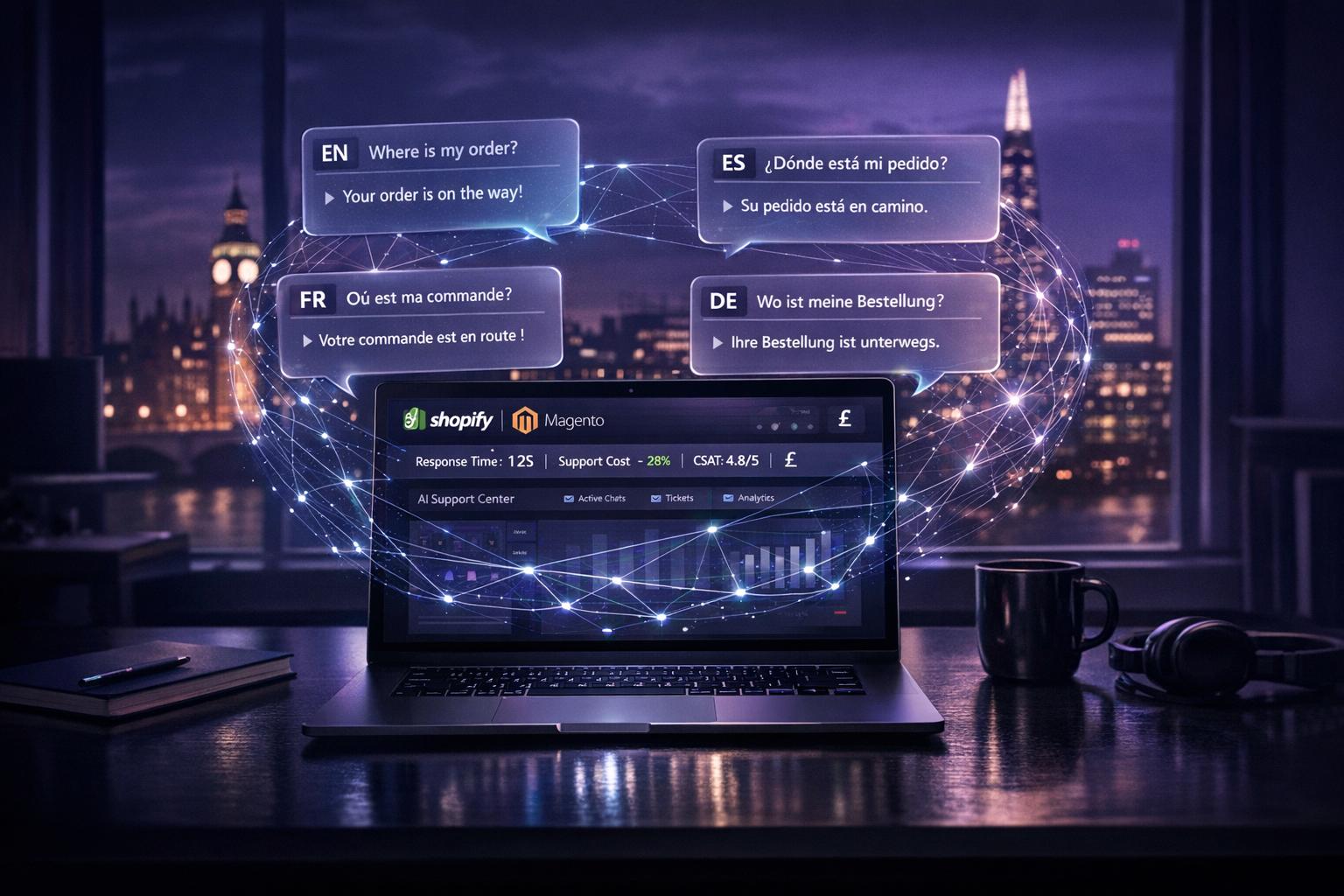
AI-powered multilingual tools are changing ecommerce support: businesses can communicate with customers in their native language across 100+ languages. These tools automate translations, improve response times by 93%, and cut support costs by up to 30%. For UK SMEs running Shopify or Magento, that means global expansion without hiring multilingual staff.
Key Highlights:
- Real-time language detection: Automatically identifies and responds in a customer’s preferred language.
- Cost savings: Cuts support costs by over 30% by automating up to 80% of common queries.
- Improved customer experience: Supports native language communication, boosting satisfaction and trust.
- Integration: Gorgias, Zendesk, and Tidio integrate directly with Shopify and Magento, offering features like order tracking and refunds in multiple languages.
Tool Overview:
- Gorgias: Ideal for Shopify users, starts at £8/month, automates 60% of queries.
- Zendesk: Best for high-volume businesses, starts at £92/agent/month, supports hundreds of languages.
- Tidio: Budget-friendly for small businesses, free plan available, automates 70% of queries.
These tools streamline global customer support, making it easier for UK ecommerce businesses to scale internationally while maintaining efficiency and customer satisfaction.
Why AI-Powered Multilingual Support Tools Matter for Ecommerce
Instant Language Translation
AI-powered tools can instantly identify a customer’s language and provide real-time, context-aware responses in over 100 languages, thanks to advanced Natural Language Processing (NLP). Imagine a French customer asking about a delayed parcel. AI tools can deliver a response that feels natural and conversational, not like a clunky translation.
These tools go beyond simple translation. They handle conversations across multiple platforms, retaining context even if a customer switches from WhatsApp to email. Some translate text within product images and adapt the entire chat interface (buttons, menus, prompts) to the customer’s language preferences. The result is a 93% reduction in response times, turning hours-long waits into seconds.
This kind of clean communication doesn’t just improve customer satisfaction. It also saves money.
Lower Costs for SMEs
Hiring multilingual staff is expensive, especially for small businesses. AI tools let one agent handle the workload of five, cutting support costs by over 30% while still managing multilingual queries efficiently.
“With Lingpad, one agent can handle the work of five, faster. Less training, more savings.” (Lingpad)
AI chatbots automate over 80% of common ecommerce queries (tracking orders, processing refunds, checking product availability) with no human input. That lets SMEs expand globally without setting up regional support centres or paying heavy translation costs. Many tools integrate directly with Shopify and Magento and go live within a week, no developers required. Usage-based pricing helps SMEs manage seasonal demand spikes while keeping 24/7 cover across time zones.
Better Customer Experience
Language barriers lead to abandoned baskets, lost sales, and frustrated customers. Supporting customers in their native language makes them feel valued, which builds trust and repeat business. Modern AI keeps your brand voice consistent across languages, so whether the customer is in London or Lisbon, your tone holds.
Paired with human oversight, these AI systems reach over 99% accuracy. Tools like Tidio’s Lyro resolve 64% of customer queries without escalation. That level of precision often beats customer expectations, which is why multilingual support is becoming a baseline rather than a nice-to-have. Research suggests native-language support will be standard practice within two years.
“In an industry where experience is everything, businesses equipped with multilingual tools are primed for higher retention, repeat business, and positive word-of-mouth.” (Flyweight AI)
AI Tools for Multilingual Ecommerce Support
Three AI tools worth knowing for multilingual support in UK ecommerce. Each brings something distinct to Shopify and Magento stores, from native integrations to smart automation.
Gorgias
For Shopify users, Gorgias stands out with its ability to automatically detect a customer’s browser language and adjust chat widgets, campaigns, and workflows accordingly. Supporting English (UK) and 14 other core languages natively, it can also extend to over 120 languages using the Tolto add-on, priced at £8 per agent per month. What makes Gorgias especially appealing is its functionality that allows agents to edit orders, process refunds, and manage returns, all within a multilingual interface.
Gorgias’ AI Agent can autonomously resolve around 60% of customer queries, including common issues like “Where is my order?” in multiple languages. In October 2025, the fashion brand Wren + Glory reported a 230% year-over-year increase in purchase volume after integrating Gorgias. Similarly, Pepper converted 19% of support conversations into sales by automating 54% of tickets. Pricing starts at £8/month for 50 tickets (Starter plan) and goes up to £720/month for the Advanced plan.
Zendesk
Zendesk is a powerful choice for handling high-volume, complex support needs. Using Natural Language Understanding (NLU), it supports hundreds of languages without relying on third-party translation tools. The platform automatically determines a customer’s language based on their location, IP address, and device, and it can even switch languages mid-conversation if necessary. This makes Zendesk ideal for UK businesses operating across multiple regions.
Additionally, Zendesk integrates with Order Management Systems (OMS), streamlining tasks like generating return labels and tracking parcels in multiple languages. Pricing starts at £92 per agent per month, with an optional advanced AI add-on for an extra £40 per agent per month. However, implementation costs (ranging from £4,000 to £16,000) make it a better fit for larger SMEs or those with dedicated support teams.
Tidio
For startups and small businesses, Tidio offers a simple yet effective solution compatible with Shopify and Magento (Adobe Commerce). Its visual, drag-and-drop “Flows” builder requires no coding, making it perfect for teams without technical expertise.
Tidio supports multi-channel communication, allowing businesses to manage interactions across WhatsApp, Instagram, and Messenger through a single multilingual inbox. With a 4.8/5 rating on the Shopify App Store based on 1,193 reviews, it’s praised for its user-friendly design and affordability. Tidio offers a free plan for up to 50 conversations per month, with paid tiers starting at £24/month (Starter) and £47/month (Growth).
Feature and Pricing Comparison
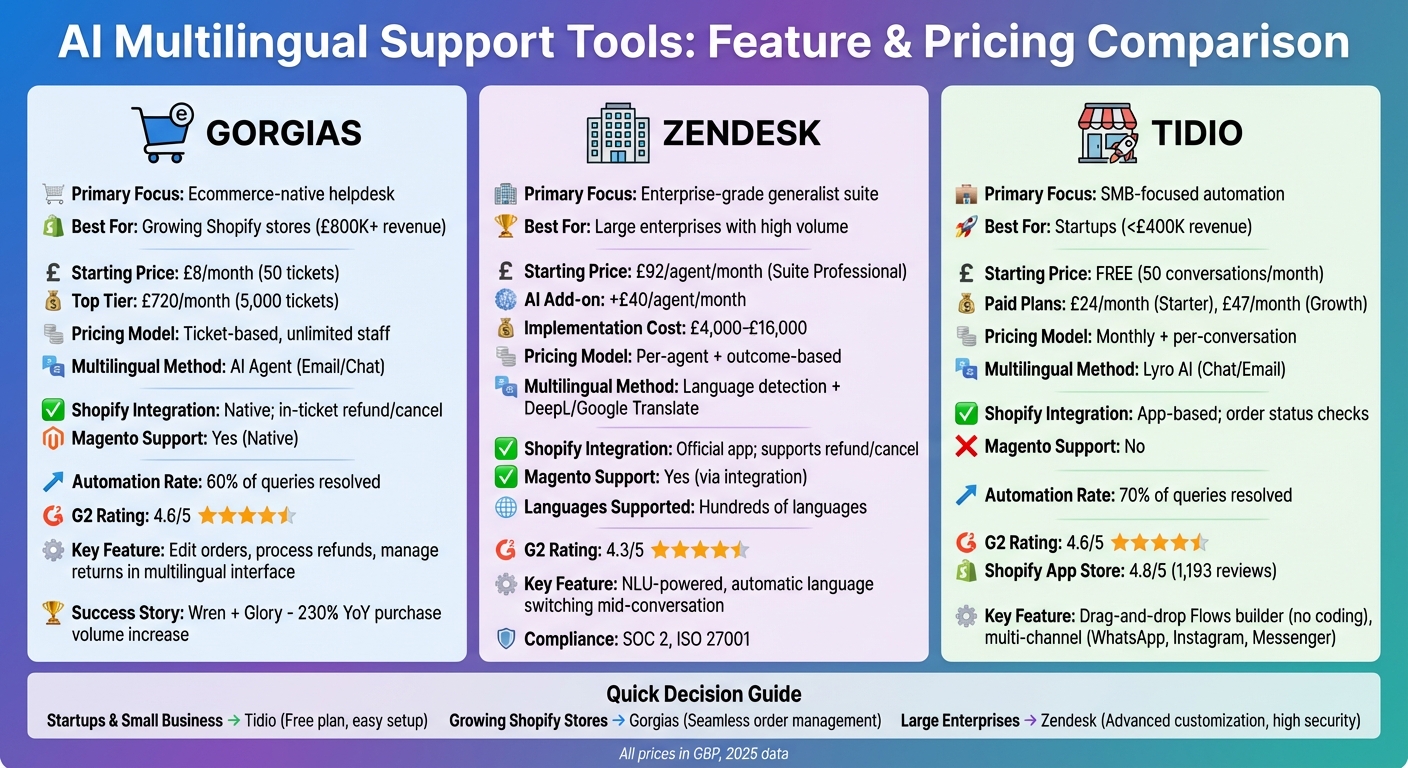
When choosing a customer support tool, it’s essential to consider pricing, features, and how well the platform aligns with your business needs. Here’s a breakdown of three popular options (Gorgias, Zendesk, and Tidio) based on their pricing models and standout features.
Gorgias offers ticket-based pricing, starting at £8/month for 50 tickets and going up to £720/month for 5,000 tickets. This plan allows unlimited staff usage, making it ideal for teams of varying sizes. Zendesk, on the other hand, uses a per-agent pricing model, with the Suite Team plan at £44/agent/month and Suite Professional at £92/agent/month. For businesses needing advanced AI capabilities, Zendesk offers an optional add-on for £40/agent/month. Tidio provides the most affordable entry point, featuring a free plan that covers 50 conversations per month. Paid plans start at £24/month (Starter) and £47/month (Growth).
Key Features
Each platform brings unique strengths to the table:
- Gorgias: Specialises in ecommerce, allowing agents to handle tasks like refunds, order cancellations, and shipping edits directly within Shopify, BigCommerce, and Magento ticket threads.
- Zendesk: Focuses on enterprise needs, offering multilingual support powered by DeepL and Google Translate, creating dynamic help centres tailored to customer language preferences.
- Tidio: Uses its Lyro AI Agent to automate up to 70% of customer queries against the business’s knowledge base. Also consolidates messages from Instagram, Facebook Messenger, and email into a single dashboard.
Comparison Table
| Feature | Gorgias | Zendesk | Tidio |
|---|---|---|---|
| Primary Focus | Ecommerce-native helpdesk | Enterprise-grade generalist suite | SMB-focused automation |
| Multilingual Method | AI Agent (Email/Chat) | Language detection + DeepL/Google Translate | Lyro AI (Chat/Email) |
| Shopify Integration | Native; in-ticket refund/cancel | Official app; supports refund/cancel | App-based; order status checks |
| Magento Support | Yes (Native) | Yes (via integration) | No |
| Pricing Model | Ticket-based | Per-agent + outcome-based | Monthly + per-conversation |
| Starting Price | £8/mo | £92/agent/mo | Free |
| G2 Rating | 4.6/5 | 4.3/5 | 4.6/5 |
Who Should Choose What?
- Startups and Small Businesses: For businesses generating less than £400,000 annually, Tidio’s free plan and its user-friendly drag-and-drop builder provide a budget-friendly solution.
- Growing Shopify Stores: Businesses with revenues over £800,000 benefit from Gorgias’s native order management tools, which streamline workflows and improve efficiency.
- Large Enterprises: Companies requiring advanced customisation, high-level security (SOC 2, ISO 27001), and extensive technical support should consider Zendesk, though implementation costs can range from £4,000 to £16,000.
Between them, these platforms show how AI-driven multilingual support and tailored features improve customer experience for businesses of every size.
Setting Up Multilingual AI Tools on Shopify and Magento

Technical Requirements
Before diving into multilingual AI support, there are a few technical steps to get right. For Magento users, start by creating an OpenAI account, setting up billing, and generating API keys. You’ll also need an extension like Magefan Translation to link your store to the API. For chatbot integration, such as Dialogflow, you’ll need to create an agent, generate a JSON service account key, and install a custom module file (module.xml) to integrate the natural language processing engine.
For Shopify, the process is more straightforward. Most AI tools are available on the Shopify App Store and can be installed with just one click. Apps like VanChat and Flyweight AI automatically sync store data, including orders and shipping details, to offer context-aware customer support. Make sure your Shopify store is running the latest version to avoid compatibility issues. Once installed, you can enable automatic language detection (supporting over 100 languages) and customise the chat widget to align with your branding. While Magento requires more detailed API configurations, Shopify’s App Store simplifies the setup process significantly.
Both platforms share some key configuration steps. For example, enabling a glossary feature ensures that brand-specific terms and product names remain consistent across all translations. To manage costs, set daily usage limits based on characters or API requests. This is particularly relevant given ChatGPT API pricing, which ranges from £0.16 per 1 million input tokens for budget models to £2 per 1 million for higher-quality translations. It’s also wise to configure a fallback language for cases where obscure dialects aren’t recognised. For legal and regulatory compliance, exclude sensitive content like cookie policies and user agreements from automated translation to guarantee precision.
Scaling Your Multilingual Support
Expanding into international markets demands automation. Transitioning from manual translations to scheduled bulk updates for product pages, SEO metadata, and marketing materials can save time and resources. For Magento, this involves setting up cron jobs or using the “Auto Translate” feature in your extension’s admin panel. Shopify merchants can use Shopify Flow to automate translation workflows whenever new products are added to their catalogue.
Scaling multilingual support effectively is essential for maintaining both operational efficiency and customer satisfaction. For example, in 2025, Waterdrop implemented the VanChat AI agent on their Shopify store, leading to a 50% improvement in customer satisfaction within three months. Similarly, Aquastrong saw a £36,000 increase in sales over two months after deploying a multilingual AI chatbot to assist international customers. These success stories highlight the benefits of a hybrid support model: using AI for routine tasks while relying on human agents for more complex issues. Before rolling out support across regions, it’s crucial to conduct beta testing with native speakers from your target markets to identify any cultural nuances the AI might overlook.
“AI-enabled multilingual workflows automate translation, regional SEO, localised support and pricing so you can scale into new markets faster and consistently.” (XgenTech)
To optimise international SEO, ensure that hreflang attributes, localised meta tags, and unique URLs are in place for each language version. High-value pages, such as your homepage, checkout process, and legal notices, should be manually reviewed to capture cultural subtleties and meet regulatory standards.
How Wingenious.ai Supports SMEs with Multilingual AI
AI Strategy Development
Rolling out multilingual AI is not a one-size-fits-all process. It needs a strategy tailored to each business. Wingenious works with UK SMEs to assess customer-service needs and design implementation plans that fit into current workflows. That means pinpointing tasks ideal for automation: answering common questions, processing returns, tracking orders.
Wingenious follows a structured 90-day playbook in four phases: Foundations, Pilot, Expansion, Hardening. It identifies key customer intents and aligns them with company policies and knowledge-base content, keeping AI responses accurate and reliable. We also assess platforms like Botpress for chat flows and Shopify Magic for content generation.
AI-Powered Customer Support Solutions
Once the strategy is in place, Wingenious helps SMEs implement multilingual support tools tailored to their needs. For example, Wilmo handles order tracking, returns and refunds in more than 40 languages. Flyweight AI is a Shopify chatbot supporting over 100 languages, with automatic language detection and real-time translation.
Conclusion
AI-driven multilingual support tools are becoming essential for UK ecommerce. They let SMEs serve international customers around the clock without additional bilingual staff. Response times drop under five seconds and costs by as much as 70%. They handle refunds and order tracking in over 50 languages while keeping the empathy and brand voice customers expect.
For choosing the right tool: Gorgias offers native Shopify integration, Zendesk suits high volumes, and Tidio provides multichannel support with free trials. The right pick depends on your specific needs for integration, scale and features. Each shows how tailored AI can simplify operations and improve customer satisfaction.
For businesses looking to go further, Wingenious offers customised support for UK SMEs, focused on AI strategy and AI-powered customer support. We work with you to identify high-volume customer queries (like “Where is my order?”) and align solutions with company policies. Leadership Discovery models measurable ROI inside three to six months without trial-and-error costs.
The shift to outcome-based pricing (you pay only for successful resolutions) and multi-agent systems that route queries to specialised AI show multilingual support is no longer optional: it is a smart, cost-efficient route to market. Pair these tools with targeted consultancy and UK SMEs can compete globally while focusing on growth.
FAQs
How accurate are AI translations for customer support?
AI translations for customer support can achieve an accuracy rate of around 98%, which is generally enough to uphold a consistent brand tone and handle customer inquiries efficiently. That said, some subtle nuances might still need a human touch to guarantee top-notch quality and clear communication.
When should a human agent take over from the AI?
When dealing with situations that are complex, sensitive, or demand a nuanced understanding, a human agent should take over. These scenarios often call for empathy and personalised judgement, qualities that AI struggles to replicate. By stepping in, human agents ensure that customers receive the care and attention they deserve during challenging times.
How can I manage translation and chatbot costs effectively?
To keep translation and chatbot expenses in check, use AI tools that streamline resource use. Features like automatic language detection and language switching cut manual tasks and reduce the need for multiple agents. High-accuracy translation models (precision close to 98%) and real-time interpretation lower the demand for human involvement. Watch your AI interaction volumes and automate frequently asked questions to keep costs in check.
Frequently asked questions.
How accurate are AI translations for customer support?
AI translations for customer support can achieve an accuracy rate of around 98%, which is generally enough to uphold a consistent brand tone and handle customer inquiries efficiently. That said, some subtle nuances might still need a human touch to guarantee top-notch quality and clear communication.
When should a human agent take over from the AI?
When dealing with situations that are complex, sensitive, or demand a nuanced understanding, a human agent should take over. These scenarios often call for empathy and personalised judgement, qualities that AI struggles to replicate. By stepping in, human agents ensure that customers receive the care and attention they deserve during challenging times.
How can I manage translation and chatbot costs effectively?
Use AI tools that streamline resource use. Features like automatic language detection and language switching cut manual tasks and reduce the need for multiple agents. High-accuracy translation models (precision close to 98%) and real-time interpretation lower the demand for human involvement. Monitor AI interaction volumes and automate frequently asked questions to keep costs in check.



Make this real in your business.
Leadership Discovery turns posts like this into a working session with your leadership team and a signed-off roadmap for your SME.